
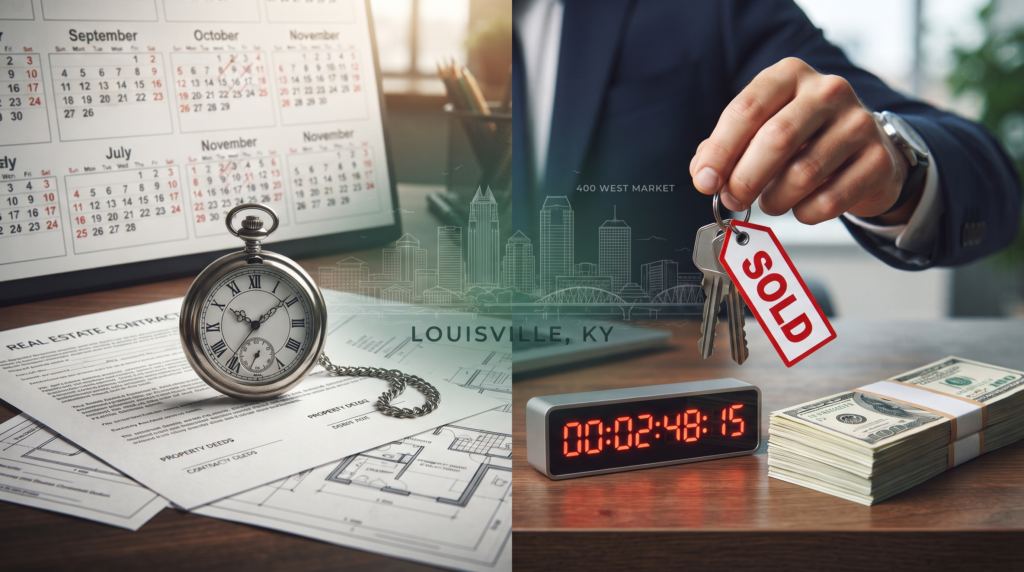
If you own a commercial property in Louisville and want to sell it, you probably have one big question: how long is this going to take?
Here’s the short, honest answer a traditional sale takes about 60 to 90 days. A cash sale can close in as little as 7 to 30 days. But the real number? It depends on your property type, your price, and who your buyer is.
Let’s break it all down so you know exactly what to expect.
The Short Answer Typical Timelines for Selling Commercial Property in Louisville
When I talk to first-time sellers, most of them think selling a commercial property takes forever. And honestly, I get it the process can feel long if you don’t know what to expect.
But here’s the good news: if you plan smart, you can move much faster than you think.
Traditional Sale Timeline 60–90 Days on Average
A traditional commercial property sale in Louisville usually takes between 60 and 90 days from listing to closing. That’s the general window most sellers should plan for.
But what happens during those days? Let me walk you through it simply.
First, you list your property on platforms like LoopNet or KCREA. Then buyers start showing interest, tours happen, and offers come in. Once you accept an offer, the buyer usually needs time to do inspections, appraisals, and get financing sorted. That part alone can take 2 to 4 weeks.
Then comes the closing signing papers, transferring the title, getting your money. That’s another 1 to 2 weeks.
So when you add it all up listing, offers, due diligence, and closing you’re looking at roughly 2 to 3 months. Some sellers move faster. Some deals take longer. Office buildings in downtown Louisville, for example, are sitting longer right now because of high vacancy rates in the CBD, sometimes 20 to 27%.
If your property is industrial or retail in a good Louisville submarket, you might see offers much faster. The Louisville commercial market for those types is strong right now.
Cash Buyer Timeline 7 to 30 Days Is Realistic
Now here’s where things get exciting for sellers who need to move fast.
A cash buyer, usually a real estate investor or investment company skips all the slow stuff. No bank loan. No appraisal wait. No financing delays. They look at your property, make an offer, and if you agree, you can close in as few as 7 to 14 days.
I once spoke with a seller who had a vacant warehouse in Louisville. He listed it on LoopNet for 6 months with zero luck. He then reached out to a cash buyer and closed in about 30 to 35 days after signing the contract. He said the process was “smooth and fast.”
The catch? Cash buyers usually offer 20 to 30% below market value. They’re taking a risk buying as-is, so they price that in. It’s a trade-off speed vs. price. If you’re facing foreclosure, going through a divorce, or just want out fast, a cash sale might be exactly what you need.
But if your property is in great shape with strong tenants and steady income, you’re probably better off waiting for a traditional buyer who’ll pay full price.
What Affects How Long It Takes to Sell Commercial Property in Louisville?
Honestly, this is the question most sellers skip and then they’re surprised when their property sits on the market for months with no offers.
The timeline isn’t random. There are real reasons why some Louisville commercial properties sell in weeks and others take a year. Let me share what actually moves the needle.
Property Type Industrial Sells Faster Than Office Right Now
Not all commercial properties are equal in Louisville right now. The type of building you own has a big effect on how fast it sells.
Industrial properties warehouses, distribution centers, storage facilities are the hottest right now. Vacancy rates in Louisville’s industrial sector are in the low single digits. That means buyers are competing for limited supply. If you own a well-located warehouse, especially near the SDF airport or along the I-65 corridor, expect serious buyer interest fast.
Retail buildings in good Louisville neighborhoods like NuLu, Highlands, or St. Matthews are also moving at a healthy pace. Core retail areas have stayed strong, with low vacancy and steady foot traffic driving buyer demand.
Office buildings are a different story. Downtown Louisville’s central business district (CBD) still has elevated vacancy somewhere between 20 and 27% depending on the building class and location. If you own office space, you may need to be more patient, more flexible on price, or more creative about targeting the right buyer.
According to the Cushman & Wakefield Q1 2025 MarketBeat Report, quarterly absorption in Louisville’s industrial and retail submarkets remains positive, while office continues to lag. That data matters when you’re setting expectations for your sale.
So before anything else know what you have. Because what you have determines how long you wait.
Price, Location, and Condition The Three Variables That Move the Needle Most
I’ll be direct here: overpricing is the number one reason commercial properties sit unsold in Louisville.
A seller I know had a small retail building in Jeffersontown. He priced it 15% above comparable sales because he “knew what it was worth.” Four months went by. Zero real offers. He finally adjusted the price and had a signed contract within two weeks.
That story isn’t unusual. The National Association of Realtors has found that properly priced properties sell up to 30% faster than overpriced ones. In commercial real estate, that gap is even bigger because the buyer pool is smaller.
Location is the second big factor. A warehouse near the airport attracts logistics buyers almost automatically. A building in Old Louisville draws developers and contractors. A neighborhood retail spot pulls local business owners. Your location tells you who your buyer is and knowing that helps you find them faster.
Condition matters more than most sellers expect. A leaky roof, broken windows, or a messy parking lot sends buyers running. One Louisville warehouse owner spent just $2,000 on basic repairs new paint, a fixed loading dock, cleaned gutters and sold for $15,000 more than his original asking price. Move-in ready properties simply sell faster, full stop.
So if you’re wondering why your property isn’t selling check the price first, then the location story you’re telling buyers, then walk through the building with fresh eyes.
Louisville Commercial Real Estate Market Snapshot (2025)
Before you list your property, it helps to know what the market is actually doing right now. A lot of sellers skip this part. They just list and hope. But if you understand what’s happening in Louisville, you can make smarter decisions about timing, pricing, and who to target as your buyer.
And right now, Louisville’s market has some really good news for sellers depending on what you own.
Which Property Sectors Are Moving Fast Right Now?
If you own industrial property in Louisville, you are in a strong position. Vacancy rates in the industrial sector are sitting in the low single digits. That means there are not many options for buyers, and the ones who are looking are serious. Quarterly absorption numbers have stayed positive, which means more space is being filled than left empty. Sellers with warehouses, distribution buildings, or storage facilities near key corridors are seeing real competition among buyers.
Retail properties in core Louisville areas are also performing well. Neighborhoods like NuLu, Highlands, and St. Matthews have stayed busy with foot traffic and business activity. Low vacancy rates in those pockets mean buyers are still actively looking.
Multifamily and mixed-use properties have held steady too. Rental demand in Louisville has not dropped off, and investors who want reliable rental income are still shopping for these assets.
The one sector that needs more patience right now is the office. The central business district (CBD) still carries elevated vacancy, somewhere between 20 and 27% depending on the building class. If you own office space, you are not stuck, but you will likely need more time and a sharper price to attract the right buyer.
The Cushman and Wakefield Q1 2025 MarketBeat Report backs all of this up. Industrial and retail submarkets in Louisville are absorbing space well. The office is the outlier.
Louisville’s Unique Market Advantages for Sellers
Here is something I think a lot of Louisville property owners do not give themselves enough credit for. This city has real advantages that outside buyers actually pay attention to.
Louisville sits right in the middle of a massive transportation web. Major highways including I-64, I-65, and I-71 all run through or near the city. The Louisville International Airport (SDF) handles serious air cargo volume, which makes it a key hub for logistics and distribution companies. That is a big reason why UPS Worldport is based here. It is the largest fully automated package handling facility in the world, and it brings a wave of supporting businesses that need commercial space nearby.
Then you have major employers like Ford Motor Company and Humana keeping the local economy stable. When big companies stay and grow, demand for commercial real estate stays healthy.
The Louisville Forward initiative is also doing real work to support business growth and development across the city. And infrastructure projects like the Waterfront Park expansion are adding value to nearby neighborhoods, which directly lifts property values in those areas.
To be fair, Louisville is not a flashy coastal market. But that is actually part of what makes it attractive to practical investors. Prices are reasonable, demand is real, and the city keeps growing. If you are selling now and your property is in a good submarket, the market is working in your favor.
Step-by-Step: How the Commercial Property Sale Process Works in Louisville
A lot of sellers come to me with the same worry. They say, “I just don’t know what happens after I decide to sell.” And I get that. The process can feel like a black box if no one has walked you through it.
So let me do that right now. Step by step. No confusing language. Just the real process, in order.
From Listing to Closing The 7 Key Stages
The whole journey from deciding to sell to getting your money usually has seven main stages. Each one takes time, and knowing how long each part takes helps you plan better.
Stage one is getting a proper property valuation. This means hiring a local commercial appraiser or working with a commercial real estate broker to find out what your property is actually worth in today’s Louisville market. This usually takes one to two weeks. Do not skip this step. I have seen sellers guess their price and waste months because they were off by 20%.
Stage two is getting your documents ready. This takes about three to five days if you are organized. You need your property deed, title, recent tax records, lease agreements, utility bills, insurance papers, inspection reports, and zoning information. Having all of this ready before you list saves you weeks later.
Stage three is listing your property. You go live on platforms like LoopNet, KCREA, and Commercial Exchange. Your broker may also do direct outreach to buyers. This happens on day one of your listing, but the marketing keeps running for weeks.
Stage four is showings and buyer outreach. This is the waiting game most sellers find hard. Serious buyers will schedule tours, ask questions, and review your documents. This stage usually runs from week one to week four, sometimes longer for office properties.
Stage five is receiving and negotiating offers. When offers come in, do not just look at the number. Look at the terms too. Closing timelines, contingencies, and financing conditions all affect how smooth the deal goes. This stage can take anywhere from a few days to a few weeks depending on how many offers you get and how much back and forth there is.
Stage six is due diligence. This is where the buyer digs deep. They do inspections, review your leases, check the zoning, and often bring in their own appraiser. Give yourself two to four weeks for this stage. It is normal. It is not a bad sign. It just takes time.
Stage seven is closing. You sign the final papers, the title company handles the transfer, and the money hits your account. This last step usually takes one to two weeks. For cash buyers, it can be even faster.
Add it all up and a traditional sale runs 60 to 90 days. A cash deal can cut that down to 30 days or less.
Documents You Need Ready Before You List
This part sounds boring. But honestly, being prepared here is one of the best things you can do to speed up your sale.
Think of it this way. When a serious buyer gets interested and asks for documents, the clock starts ticking. If you fumble around looking for old lease agreements or cannot find your last inspection report, buyers get nervous. Some walk away. I have seen it happen.
Here is what you want to have ready before your property even goes live.
Your property deed and clean title are the starting point. Buyers need to know there are no surprises with ownership. Your recent tax records show the financial history of the property. If you have tenants, get your lease agreements organized and note how long each one runs. Buyers love stable, long-term tenants because it means income from day one.
Pull together your utility bills for the last 12 months. Have your insurance papers current and accessible. If you have had any inspections done recently, keep those reports handy. And make sure you know your zoning classification because buyers always ask, especially if they plan to change how the property is used.
Finally, put together a simple record of any repairs or maintenance work done in the last few years. A new roof, a repainted parking lot, a replaced HVAC unit. These details matter to buyers and they help justify your price.
Sellers who show up prepared to close faster. It really is that simple. The buyers feel confident, the process moves smoothly, and you spend less time waiting around.
Cash Buyers vs. Traditional Buyers Which Is Right for Your Louisville Property?
This is one of those decisions that feels confusing at first but gets really clear once you understand what each type of buyer actually means for you as a seller.
I always tell people there is no universally right answer here. It depends on your property, your situation, and honestly, how much time you have.
When a Cash Sale Makes Sense in Louisville
Let me paint a picture. You inherited a commercial building in Louisville from a family member. It has been sitting empty for months. The roof needs work. You live in another state. You just want it gone without dealing with repairs, showings, and months of waiting.
That is exactly the situation where a cash buyer makes total sense.
Cash buyers are usually real estate investors or investment companies that buy properties quickly, pay in full without a bank loan, and close fast. We are talking 7 to 14 days in many cases. Sometimes up to 30. They buy as-is, meaning you do not have to fix anything before selling.
This works really well in specific situations. If you are facing foreclosure and need to stop the clock fast, a cash sale can save you. If you are going through a divorce and both parties just want to move on, cash is clean and quick. If you are a tired landlord dealing with broken pipes and late paying tenants, a cash offer lets you walk away without fixing a thing.
The trade off is real though. Cash buyers typically offer 20 to 30% below market value. They are taking on the risk and the repairs, so they price that into their offer. A property worth $500,000 on the open market might get a cash offer of $350,000 to $400,000.
So ask yourself one simple question. Is the speed and simplicity worth more to you right now than the extra money? For a lot of sellers, the answer is yes.
When a Traditional Sale Gets You More Money
Now flip the situation. You own a well maintained retail building in St. Matthews. You have two long term tenants. The lease agreements run for another three years. Your net operating income (NOI) is strong and growing. You are not in a rush.
In that case, a traditional sale is almost always the better move.
A traditional buyer whether that is another investor, a business owner, or a developer will pay much closer to full market value. In some cases, especially for well performing industrial or retail properties in Louisville right now, you might even get offers above asking.
Here is a real example that stuck with me. A Louisville seller had a retail building in great condition priced at $400,000. A cash buyer offered $320,000. He waited, listed traditionally, and got a $520,000 offer from a traditional buyer 75 days later. That is $200,000 more just for being patient.
To be fair, not every traditional sale goes that smoothly. The process takes longer. You deal with inspections, appraisals, buyer financing conditions, and more back and forth. A deal can fall through if the buyer’s bank pulls out. That does not happen with cash.
But if your property is in good shape, has stable tenants, and sits in a strong Louisville submarket like Jeffersontown, NuLu, or near the SDF airport, the traditional route will almost always put more money in your pocket.
The funny part is most sellers I talk to already know which category they fall into. They just need someone to confirm it. So which one sounds more like your situation?
What Affects How Long It Takes to Sell Commercial Property in Louisville?
Honestly, this is the question most sellers skip and then they’re surprised when their property sits on the market for months with no offers.
The timeline isn’t random. There are real reasons why some Louisville commercial properties sell in weeks and others take a year. Let me share what actually moves the needle.
Property Type Industrial Sells Faster Than Office Right Now
Not all commercial properties are equal in Louisville right now. The type of building you own has a big effect on how fast it sells.
Industrial properties warehouses, distribution centers, storage facilities are the hottest right now. Vacancy rates in Louisville’s industrial sector are in the low single digits. That means buyers are competing for limited supply. If you own a well-located warehouse, especially near the SDF airport or along the I-65 corridor, expect serious buyer interest fast.
Retail buildings in good Louisville neighborhoods like NuLu, Highlands, or St. Matthews are also moving at a healthy pace. Core retail areas have stayed strong, with low vacancy and steady foot traffic driving buyer demand.
Office buildings are a different story. Downtown Louisville’s central business district (CBD) still has elevated vacancy somewhere between 20 and 27% depending on the building class and location. If you own office space, you may need to be more patient, more flexible on price, or more creative about targeting the right buyer.
According to the Cushman & Wakefield Q1 2025 MarketBeat Report, quarterly absorption in Louisville’s industrial and retail submarkets remains positive, while office continues to lag. That data matters when you’re setting expectations for your sale.
So before anything else know what you have. Because what you have determines how long you wait.
Price, Location, and Condition The Three Variables That Move the Needle Most
I’ll be direct here: overpricing is the number one reason commercial properties sit unsold in Louisville.
A seller I know had a small retail building in Jeffersontown. He priced it 15% above comparable sales because he “knew what it was worth.” Four months went by. Zero real offers. He finally adjusted the price and had a signed contract within two weeks.
That story isn’t unusual. The National Association of Realtors has found that properly priced properties sell up to 30% faster than overpriced ones. In commercial real estate, that gap is even bigger because the buyer pool is smaller.
Location is the second big factor. A warehouse near the airport attracts logistics buyers almost automatically. A building in Old Louisville draws developers and contractors. A neighborhood retail spot pulls local business owners. Your location tells you who your buyer is and knowing that helps you find them faster.
Condition matters more than most sellers expect. A leaky roof, broken windows, or a messy parking lot sends buyers running. One Louisville warehouse owner spent just $2,000 on basic repairs new paint, a fixed loading dock, cleaned gutters and sold for $15,000 more than his original asking price. Move-in ready properties simply sell faster, full stop.
So if you’re wondering why your property isn’t selling check the price first, then the location story you’re telling buyers, then walk through the building with fresh eyes.
Louisville Commercial Real Estate Market Snapshot (2025)
Before you list your property, it helps to know what the market is actually doing right now. A lot of sellers skip this part. They just list and hope. But if you understand what’s happening in Louisville, you can make smarter decisions about timing, pricing, and who to target as your buyer.
And right now, Louisville’s market has some really good news for sellers depending on what you own.
Which Property Sectors Are Moving Fast Right Now?
If you own industrial property in Louisville, you are in a strong position. Vacancy rates in the industrial sector are sitting in the low single digits. That means there are not many options for buyers, and the ones who are looking are serious. Quarterly absorption numbers have stayed positive, which means more space is being filled than left empty. Sellers with warehouses, distribution buildings, or storage facilities near key corridors are seeing real competition among buyers.
Retail properties in core Louisville areas are also performing well. Neighborhoods like NuLu, Highlands, and St. Matthews have stayed busy with foot traffic and business activity. Low vacancy rates in those pockets mean buyers are still actively looking.
Multifamily and mixed-use properties have held steady too. Rental demand in Louisville has not dropped off, and investors who want reliable rental income are still shopping for these assets.
The one sector that needs more patience right now is the office. The central business district (CBD) still carries elevated vacancy, somewhere between 20 and 27% depending on the building class. If you own office space, you are not stuck, but you will likely need more time and a sharper price to attract the right buyer.
The Cushman and Wakefield Q1 2025 MarketBeat Report backs all of this up. Industrial and retail submarkets in Louisville are absorbing space well. The office is the outlier.
Louisville’s Unique Market Advantages for Sellers
Here is something I think a lot of Louisville property owners do not give themselves enough credit for. This city has real advantages that outside buyers actually pay attention to.
Louisville sits right in the middle of a massive transportation web. Major highways including I-64, I-65, and I-71 all run through or near the city. The Louisville International Airport (SDF) handles serious air cargo volume, which makes it a key hub for logistics and distribution companies. That is a big reason why UPS Worldport is based here. It is the largest fully automated package handling facility in the world, and it brings a wave of supporting businesses that need commercial space nearby.
Then you have major employers like Ford Motor Company and Humana keeping the local economy stable. When big companies stay and grow, demand for commercial real estate stays healthy.
The Louisville Forward initiative is also doing real work to support business growth and development across the city. And infrastructure projects like the Waterfront Park expansion are adding value to nearby neighborhoods, which directly lifts property values in those areas.
To be fair, Louisville is not a flashy coastal market. But that is actually part of what makes it attractive to practical investors. Prices are reasonable, demand is real, and the city keeps growing. If you are selling now and your property is in a good submarket, the market is working in your favor.
Step-by-Step: How the Commercial Property Sale Process Works in Louisville
A lot of sellers come to me with the same worry. They say, “I just don’t know what happens after I decide to sell.” And I get that. The process can feel like a black box if no one has walked you through it.
So let me do that right now. Step by step. No confusing language. Just the real process, in order.
From Listing to Closing The 7 Key Stages
The whole journey from deciding to sell to getting your money usually has seven main stages. Each one takes time, and knowing how long each part takes helps you plan better.
Stage one is getting a proper property valuation. This means hiring a local commercial appraiser or working with a commercial real estate broker to find out what your property is actually worth in today’s Louisville market. This usually takes one to two weeks. Do not skip this step. I have seen sellers guess their price and waste months because they were off by 20%.
Stage two is getting your documents ready. This takes about three to five days if you are organized. You need your property deed, title, recent tax records, lease agreements, utility bills, insurance papers, inspection reports, and zoning information. Having all of this ready before you list saves you weeks later.
Stage three is listing your property. You go live on platforms like LoopNet, KCREA, and Commercial Exchange. Your broker may also do direct outreach to buyers. This happens on day one of your listing, but the marketing keeps running for weeks.
Stage four is showings and buyer outreach. This is the waiting game most sellers find hard. Serious buyers will schedule tours, ask questions, and review your documents. This stage usually runs from week one to week four, sometimes longer for office properties.
Stage five is receiving and negotiating offers. When offers come in, do not just look at the number. Look at the terms too. Closing timelines, contingencies, and financing conditions all affect how smooth the deal goes. This stage can take anywhere from a few days to a few weeks depending on how many offers you get and how much back and forth there is.
Stage six is due diligence. This is where the buyer digs deep. They do inspections, review your leases, check the zoning, and often bring in their own appraiser. Give yourself two to four weeks for this stage. It is normal. It is not a bad sign. It just takes time.
Stage seven is closing. You sign the final papers, the title company handles the transfer, and the money hits your account. This last step usually takes one to two weeks. For cash buyers, it can be even faster.
Add it all up and a traditional sale runs 60 to 90 days. A cash deal can cut that down to 30 days or less.
Documents You Need Ready Before You List
This part sounds boring. But honestly, being prepared here is one of the best things you can do to speed up your sale.
Think of it this way. When a serious buyer gets interested and asks for documents, the clock starts ticking. If you fumble around looking for old lease agreements or cannot find your last inspection report, buyers get nervous. Some walk away. I have seen it happen.
Here is what you want to have ready before your property even goes live.
Your property deed and clean title are the starting point. Buyers need to know there are no surprises with ownership. Your recent tax records show the financial history of the property. If you have tenants, get your lease agreements organized and note how long each one runs. Buyers love stable, long-term tenants because it means income from day one.
Pull together your utility bills for the last 12 months. Have your insurance papers current and accessible. If you have had any inspections done recently, keep those reports handy. And make sure you know your zoning classification because buyers always ask, especially if they plan to change how the property is used.
Finally, put together a simple record of any repairs or maintenance work done in the last few years. A new roof, a repainted parking lot, a replaced HVAC unit. These details matter to buyers and they help justify your price.
Sellers who show up prepared to close faster. It really is that simple. The buyers feel confident, the process moves smoothly, and you spend less time waiting around.
Cash Buyers vs. Traditional Buyers Which Is Right for Your Louisville Property?
This is one of those decisions that feels confusing at first but gets really clear once you understand what each type of buyer actually means for you as a seller.
I always tell people there is no universally right answer here. It depends on your property, your situation, and honestly, how much time you have.
When a Cash Sale Makes Sense in Louisville
Let me paint a picture. You inherited a commercial building in Louisville from a family member. It has been sitting empty for months. The roof needs work. You live in another state. You just want it gone without dealing with repairs, showings, and months of waiting.
That is exactly the situation where a cash buyer makes total sense.
Cash buyers are usually real estate investors or investment companies that buy properties quickly, pay in full without a bank loan, and close fast. We are talking 7 to 14 days in many cases. Sometimes up to 30. They buy as-is, meaning you do not have to fix anything before selling.
This works really well in specific situations. If you are facing foreclosure and need to stop the clock fast, a cash sale can save you. If you are going through a divorce and both parties just want to move on, cash is clean and quick. If you are a tired landlord dealing with broken pipes and late paying tenants, a cash offer lets you walk away without fixing a thing.
The trade off is real though. Cash buyers typically offer 20 to 30% below market value. They are taking on the risk and the repairs, so they price that into their offer. A property worth $500,000 on the open market might get a cash offer of $350,000 to $400,000.
So ask yourself one simple question. Is the speed and simplicity worth more to you right now than the extra money? For a lot of sellers, the answer is yes.
When a Traditional Sale Gets You More Money
Now flip the situation. You own a well maintained retail building in St. Matthews. You have two long term tenants. The lease agreements run for another three years. Your net operating income (NOI) is strong and growing. You are not in a rush.
In that case, a traditional sale is almost always the better move.
A traditional buyer whether that is another investor, a business owner, or a developer will pay much closer to full market value. In some cases, especially for well performing industrial or retail properties in Louisville right now, you might even get offers above asking.
Here is a real example that stuck with me. A Louisville seller had a retail building in great condition priced at $400,000. A cash buyer offered $320,000. He waited, listed traditionally, and got a $520,000 offer from a traditional buyer 75 days later. That is $200,000 more just for being patient.
To be fair, not every traditional sale goes that smoothly. The process takes longer. You deal with inspections, appraisals, buyer financing conditions, and more back and forth. A deal can fall through if the buyer’s bank pulls out. That does not happen with cash.
But if your property is in good shape, has stable tenants, and sits in a strong Louisville submarket like Jeffersontown, NuLu, or near the SDF airport, the traditional route will almost always put more money in your pocket.
The funny part is most sellers I talk to already know which category they fall into. They just need someone to confirm it. So which one sounds more like your situation?
How to Sell Your Commercial Property Faster in Louisville Without Leaving Money on the Table
Most guides on this topic give you a generic list of tips that could apply anywhere in the country. I want to do something different. I want to talk about what actually works specifically in Louisville, based on how this market behaves and what buyers here are actually looking for.
Because selling fast and selling smart are not opposites. You can do both.
Price It Right From Day One Overpricing Is the Number One Deal Killer
I will be honest with you. Overpricing is the single biggest mistake I see Louisville commercial property sellers make. And it is painful to watch because it is so avoidable.
Here is what happens. A seller thinks their building is worth more than the market says. They list high. The first two weeks go by with a lot of views but no serious offers. Then weeks three and four pass. Then month two. By month three, buyers start wondering what is wrong with the property. Why has it been sitting so long? Even if nothing is wrong, a long days on market number scares buyers away.
The National Association of Realtors found that properly appraised and priced properties sell up to 30% faster than overpriced ones. In commercial real estate that gap is even wider because the buyer pool is smaller to begin with.
I remember talking to a seller who owned a warehouse in Jeffersontown. He priced it based on what he paid for it years ago plus what he felt it was worth emotionally. Four months. Zero real offers. He finally got a proper commercial appraisal done, adjusted his price to match comparable sales in the area, and had a signed contract within two weeks.
A few hundred dollars spent on a professional appraisal can save you months of frustration. It gives you a defensible number to show buyers and it protects you in negotiations too. When a buyer tries to lowball you, you can point to the appraisal and hold your ground with confidence.
One more thing. Do not price based on what you need from the sale. Price based on what the Louisville market says the property is worth. Those are two very different numbers and confusing them costs sellers real money.
Target the Right Buyer for Your Property Type
This one changed how I think about selling commercial property completely. Most sellers broadcast their listing to everyone and hope the right person sees it. The smarter move is to figure out who your most likely buyer is and go directly to them.
Think about it this way. If you have a warehouse near the SDF airport, your ideal buyers are logistics companies, distributors, and freight operators. They need that location. They understand its value better than anyone. So instead of just listing on LoopNet and waiting, reach out directly. Call local logistics companies. Email regional distributors. Post in Louisville business groups on Facebook. One seller I know had a vacant building in Old Louisville and instead of waiting for buyers to come to him, he contacted local contractors and developers directly. He had 10 inquiries within a week and an offer at asking price shortly after.
If you own a small retail building in a neighborhood like Highlands or Germantown, your buyer is probably a local business owner or a small family looking to open a shop. That person is not scrolling LoopNet every day. They might be on Facebook Marketplace, in local business groups, or connected to someone at the Louisville Chamber of Commerce.
Your commercial real estate broker should be doing this targeted outreach for you. If they are just listing your property and waiting, that is not enough. The best brokers in Louisville use their buyer contacts, their investor networks, and direct marketing to find the right person faster.
And when you do find a serious buyer, respond fast. I mean within 24 hours fast. Buyers who are ready to move lose interest quickly if sellers are slow to respond. Speed on your end encourages speed on theirs.
Tax Implications That Affect Your Timeline Decision in Louisville
Most sellers think about price. They think about buyers. They think about closing dates. But very few think about taxes until the deal is almost done and by then, it is sometimes too late to plan properly.
I want to talk about this early because taxes can actually change when you decide to sell, not just what happens after you sell. And if you are sitting on a Louisville commercial property that has gone up in value, the tax piece is a big deal.
Capital Gains Tax What Louisville Sellers Need to Know
When you sell a commercial property for more than you paid for it, the profit is called a capital gain. And the government wants a piece of it.
Here is how it works in simple terms. Say you bought a retail building in Louisville for $300,000 a few years ago. Today you sell it for $500,000. That $200,000 difference is your capital gain. You do not keep all of it.
According to the IRS, for tax year 2025, the long-term capital gains tax rate for most individuals is no higher than 15%. However, if your total taxable income is high enough, that rate goes up to 20%. You can read the exact breakdown directly on the IRS website at IRS Topic No. 409 Capital Gains and Losses.
On top of that, Kentucky has its own state income tax. So when you add federal and state taxes together, a good chunk of your profit can go to the government if you do not plan ahead.
The exact amount you owe depends on how long you owned the property, your total income for the year, and how the property was used. This is why talking to a tax professional or real estate attorney before you list is one of the smartest moves you can make. Not after the deal closes before.
I always say this: the people who wait until closing day to think about taxes are the ones who are most surprised. A little planning early can save you tens of thousands of dollars.
The 1031 Exchange Option Defer Taxes and Keep Investing
Here is where things get really interesting for Louisville sellers who want to keep their money working instead of handing it to the IRS right away.
A 1031 exchange named after IRS Section 1031 lets you sell your commercial property and reinvest the money into another like-kind property without paying capital gains tax right away. You are not escaping the tax forever. You are pushing it down the road while your money keeps growing.
According to the IRS, as confirmed in their official guidance on Like-Kind Exchanges under IRC Section 1031, there are two strict deadlines you must follow.
First, you have 45 days from the date you sell your property to identify the replacement property in writing. Second, you must close on that replacement property within 180 days of your original sale. Miss either of those deadlines and you lose the tax benefit entirely.
You also need someone called a qualified intermediary a neutral third party who holds your sale money during the exchange. You cannot touch the funds yourself or the exchange becomes invalid. This is not optional. It is a firm IRS rule.
I talked to a seller once who had a warehouse in Louisville that he sold for a solid profit. Instead of paying a large tax bill, he used a 1031 exchange to roll that money into two smaller rental properties in another state. His income did not drop. His tax bill got deferred. And he felt like he made his money work twice.
The key thing to remember is this a 1031 exchange must be planned before you close your sale, not after. Once the money hits your account directly, the window closes. So if this strategy interests you, bring it up with your broker and a qualified tax advisor early in the process.
Honestly, for any Louisville seller with a property that has grown significantly in value, this is worth exploring seriously. The savings can be substantial.
Should You Sell Now or Hold? A Quick Framework for Louisville Owners
This is the question I get asked more than almost any other. And honestly, there is no single right answer that works for everyone. But there is a clear way to think through it and once you do, the decision usually becomes pretty obvious.
Let me share a simple framework that actually works.
Signs the Louisville Market Is Telling You to Sell
The first sign is equity. If your commercial property has gone up significantly in value over the last few years and you are sitting on a large amount of equity, this might be your best window to pull it out. Cap rates in Louisville’s industrial and retail sectors have compressed, meaning buyers are willing to pay more per dollar of income than they were a few years ago. That is good news for sellers.
The second sign is income trouble. If your net operating income (NOI) has been dropping, tenants are leaving, or the building is sitting with rising vacancy, holding is not helping you. A property that is losing ground financially is not a wealth builder it is a drain. Selling now while the asset still has value beats waiting until the problems get worse.
The third sign is an unsolicited offer above market. If a buyer has approached you out of nowhere and offered 20% or more above comparable sales, pay attention. That kind of offer does not come around often. I have seen sellers turn those down hoping for more, only to watch the market shift and wish they had taken it.
The fourth sign is a life change. Retirement, divorce, relocation, or wanting to simplify your life are all completely valid reasons to sell. Real estate is a tool for your life not the other way around. If the property no longer fits where you are going, selling makes sense regardless of what the market is doing.
And if you are thinking about a 1031 exchange to reinvest into something more passive like a net lease property that requires zero management selling during a strong market gives you the most equity to roll forward.
Signs You Should Hold and Collect Income Instead
Now let me flip it. If your property has strong, long-term tenants locked into solid lease agreements, your NOI is growing, and your cash-on-cash return is healthy why sell? You have what every investor is looking for. Walking away from that is often a mistake.
Louisville’s infrastructure projects are also adding real value to certain neighborhoods right now. Areas near the Waterfront Park expansion, parts of NuLu, and corridors along the major highway routes are seeing property value appreciation that has not fully played out yet. If your building sits in one of those areas, holding another few years could mean significantly more equity.
Holding also lets you delay the capital gains tax conversation entirely. Every year you hold, that tax bill stays deferred. And if you eventually pass the property on, your heirs receive what is called a stepped-up basis which can reduce their tax burden significantly.
If your property is generating reliable monthly income, you are not losing anything by waiting. The rent keeps coming in. The mortgage keeps getting paid down if you have one. And your options stay open.
One seller I know held a strip retail center in Louisville for over a decade. Every few years someone told him to sell. He kept holding. Steady tenants, growing rents, no drama. He finally sold when he was ready on his terms, at a price that reflected years of appreciation. That kind of patience rewarded him far better than any rushed exit would have.
The honest takeaway is this. If your property is working for you financially and personally, hold. If it has stopped working financially, emotionally, or practically sell. The market conditions in Louisville right now are favorable enough that either decision, made thoughtfully, can be the right one.
Working With a Commercial Real Estate Broker in Louisville Worth It?
Short answer yes, in most cases. But the longer answer depends on what kind of property you have, how complex your deal is, and what you need from the process.
Let me break it down honestly.
What a Louisville Commercial Broker Actually Does for You
A good commercial real estate broker in Louisville does a lot more than just list your property on LoopNet and wait for calls. The best ones bring a network of active buyers, investors, and developers who are already looking for properties like yours. That network alone can cut weeks off your sale timeline.
They also handle the pricing conversation properly. A broker with real Louisville market experience knows what comparable sales look like in Jeffersontown, NuLu, St. Matthews, and the CBD right now. They will tell you an honest number not the number you want to hear. And that honesty usually saves you months of sitting on an overpriced listing.
On top of that, they manage showings, handle buyer questions, organize your due diligence documents, and negotiate on your behalf. If a buyer tries to chip away at your price after inspection, a skilled broker knows how to push back with data instead of emotion.
The cost is typically a commission of 4 to 6% of the sale price. On a $500,000 property that is $20,000 to $30,000. That sounds like a lot. But if a broker gets you $50,000 more than you would have gotten on your own and closes the deal two months faster the math works in your favor.
For sellers who want to save on commission, flat fee brokerage options do exist in Louisville. You pay a set fee upfront for listing services and handle more of the process yourself. That can work well for straightforward properties with strong demand. But for complex deals multi-tenant buildings, properties with zoning questions, or anything that needs creative marketing full service is usually worth it.
CCIM vs. General Realtor Does Specialization Matter?
This one matters more than most sellers realize.
A CCIM which stands for Certified Commercial Investment Member is a designation that takes years of education, experience, and testing to earn. It specifically covers commercial real estate analysis, including NOI calculations, cap rate interpretation, 1031 exchange strategy, lease analysis, and investment valuation. It is not a general real estate license with a commercial add-on. It is a separate, rigorous credential.
A general real estate agent who mostly handles homes can technically list a commercial property. But if your building has multiple tenants, a complex lease agreement, or a buyer who wants to dig deep into the financials, a general agent may struggle to answer the questions that come up. That hesitation can cost you a deal.
For simpler commercial properties a single-tenant retail building in good shape with clean paperwork a knowledgeable general broker might do fine. But for anything with real complexity a mixed-use building, an industrial property with specialized zoning, or a deal involving a 1031 exchange working with a CCIM-designated broker gives you a meaningful advantage.
Think of it this way. If you had a complicated legal case, you would want a specialist, not a general practitioner. Commercial real estate is the same. The more complex your deal, the more specialization matters.
Conclusion
Selling a commercial property in Louisville is not a single decision it is a series of decisions, each one affecting how fast you sell, how much you walk away with, and how smoothly the whole thing goes.
Here is what you now know. A traditional sale takes roughly 60 to 90 days. A cash sale can close in as little as 7 to 30 days. Industrial and retail properties in Louisville are moving well right now. Office space needs more patience and sharper pricing. Getting the price right from day one is the single biggest factor in your timeline. And the tax conversation especially around capital gains and 1031 exchanges needs to happen before you list, not after.
Louisville is a solid market for sellers right now. The city’s location, its strong employer base, and steady buyer demand across most property types all work in your favor. But like any real estate deal, preparation and the right team make all the difference.
If you are thinking about selling your Louisville commercial property, start by getting a proper commercial appraisal, organizing your documents, and speaking with both a commercial broker and a tax advisor before you do anything else. That preparation will save you time, money, and stress.
I would love to hear where you are in the process. Are you ready to sell, still on the fence, or just starting to think it through? Drop your thoughts every situation is different and there is almost always a smart path forward.
Frequently Asked Questions
How long does it take to sell a commercial property in Louisville on average?
The honest answer is it depends on how you sell and what you own. A traditional commercial property sale in Louisville takes roughly 60 to 90 days from listing to closing. That includes time for marketing, showings, offer negotiations, due diligence, and the final closing process. If you sell to a cash buyer, that timeline drops significantly as many cash deals close in 7 to 30 days. Office properties in downtown Louisville tend to take longer right now because of high vacancy rates in the CBD. Industrial and retail properties in strong submarkets move faster. So the short answer is anywhere from 2 weeks to 3 months, depending on your situation.
What type of commercial property sells fastest in Louisville right now?
Industrial properties are the fastest moving asset class in Louisville right now. Vacancy rates in the industrial sector are sitting in the low single digits, which means buyers are actively competing for available space. Warehouses and distribution buildings, especially those near the SDF airport or along the I-65 corridor, are in particularly strong demand thanks to Louisville’s role as a major logistics hub. Retail properties in neighborhoods like NuLu, Highlands, and St. Matthews are also performing well. Office space especially in the central business district is the slowest category right now and requires more time, flexible pricing, and targeted marketing to find the right buyer.
Can I sell my Louisville commercial property without a real estate agent?
Yes, you can. Selling without an agent sometimes called FSBO or using a flat fee listing service is an option, and some sellers do it successfully. You save on the broker commission, which typically runs 4 to 6% of the sale price. But here is the trade-off. Without an agent, you handle pricing, marketing, buyer outreach, showings, negotiations, and paperwork on your own. For a straightforward property with strong demand, that might be manageable. For anything more complex a multi-tenant building, a property with zoning questions, or a deal involving a 1031 exchange going without professional help can cost you more in mistakes than the commission would have. Most experienced sellers agree that a good commercial broker more than earns their fee on anything above a basic transaction.
How do I avoid capital gains tax when selling commercial property in Louisville?
The most widely used legal strategy is the 1031 exchange, named after IRS Section 1031. It allows you to sell your commercial property and reinvest the proceeds into another like-kind property without paying capital gains tax immediately. According to the IRS, you have 45 days after your sale to identify a replacement property in writing, and 180 days to close on it. You must use a qualified intermediary to hold the funds during the exchange you cannot touch the money yourself. If you follow the rules correctly, your capital gains tax gets deferred, sometimes for many years. This strategy works best when planned well before your closing date, not after. Always work with a tax professional or real estate attorney who knows Louisville and Kentucky tax rules before moving forward. For full IRS details, you can visit the official IRS page on Like-Kind Exchanges here.
What documents do I need to sell commercial property in Louisville quickly?
Being prepared with the right documents before you list is one of the easiest ways to speed up your sale. Buyers move faster when everything is organized and ready. Here is what you want to have in hand before your property goes live.
Start with your property deed and a clean title buyers need to confirm ownership with no surprises. Pull together your recent tax records for the last two to three years. If you have tenants, organize all lease agreements clearly, including start dates, end dates, and rent amounts. Buyers love seeing stable, long-term leases because it means income from day one.
Also gather your last 12 months of utility bills, your current insurance papers, any recent inspection reports, and your zoning classification documents. Finally, keep a simple record of any repairs or improvements made in recent years a new roof, updated HVAC, parking lot repairs. Sellers who show up with all of this ready consistently close faster and with fewer surprises along the way.
