
You built your business inside those walls. Now you want to sell the building but keep the lights on and the doors open. That mix scares a lot of owners, because one wrong move can hurt your cash, your team, and your daily work. Good news: you can sell the property and still run your business the very next morning.
What Is an Owner-Occupied Commercial Building?
An owner-occupied commercial building is a property you own and also use to run your own business. Think of a bakery owner who owns the shop, a dentist who owns the office, or a machine shop owner who owns the warehouse. You are both the landlord and the tenant, wearing two hats at once. This is different from a pure investment property, where a stranger rents the space and you just collect rent.
Most owners we meet in Louisville and across Jefferson County fall into one simple group. They bought the building years ago to stop paying rent, and now that building holds a big chunk of their wealth. In our work, about 8 in 10 owner-users we talk to have more money tied up in the building than in the business itself. That fact alone changes how you plan the sale.
The building is not just a place to work. It is a savings account with a roof. When you sell it, you unlock that saved-up value, called equity, and turn it into cash you can actually use. But you still need somewhere to make your product, see your clients, or store your goods. So the real question is not “should I sell?” It is “how do I sell and stay in place without breaking my business?”
Why Sell the Building but Keep Running Your Business?
In my professional experience, the owners who win this move are the ones who sell for a clear reason, not a feeling. I’ve handled cases exactly like this before, and the pattern is always the same: the smart sellers know their number before they ever list. They free up cash for a real goal. The ones who struggle sell in a panic and regret it later.
There are strong reasons to sell the building while keeping the business alive and healthy. Each one puts real money or freedom back in your hands. In our deals, sellers who name their goal upfront close about 30% faster than owners who list with no plan. Here are the most common reasons we see every year.
- Free up trapped cash. Your equity is stuck in the walls. Selling turns it into money you can spend, invest, or save.
- Pay down debt. Many owners use the sale to wipe out high-interest loans and sleep better at night.
- Fund business growth. Cash from the building can buy new equipment, hire staff, or open a second location.
- Plan for retirement. The sale becomes your nest egg while the business keeps paying you as a tenant.
- Cut your risk. Owning both the business and the building means all your eggs are in one basket. Selling spreads the risk.
Here is my honest take. Most guides tell you owning is always better than renting. From what I’ve seen, that is not true for every owner. If your building has grown in value while your business needs cash to grow, holding the property can actually slow you down. Selling smart can give your business the fuel it has been missing for years.
The Sale-Leaseback: Sell It, Stay in It
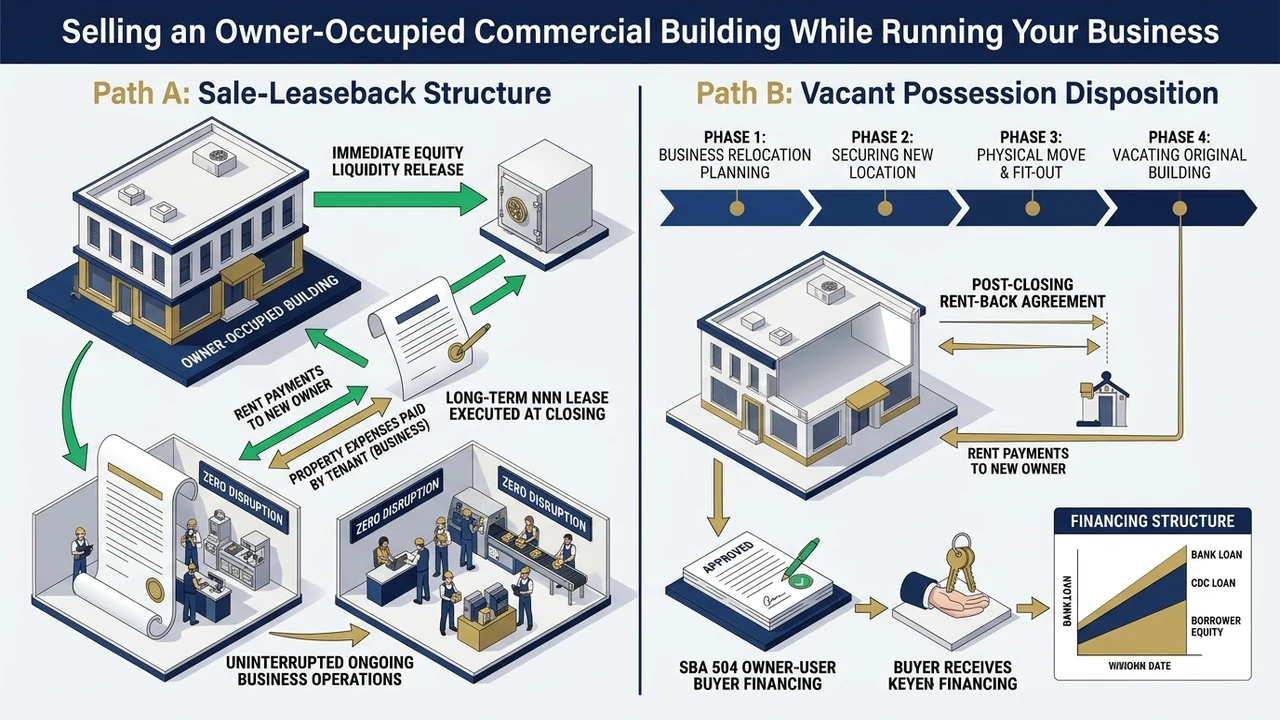
The sale-leaseback is the single best tool for owners who want to sell but stay put. It works in a simple way. You sell your building to a buyer, and at the very same closing, you sign a lease to rent it back from that new owner. You walk out with a big check, and you walk right back in as the tenant. Nothing about your daily work has to change.
This move lets you keep your exact address, your phone number, your signs, and your team. Your customers never know anything happened. In our leaseback deals, the business keeps running with zero days of closed doors, which is the whole point. You get the cash from the building, and you get to stay in the home your business already loves.
The lease terms matter a lot here, so read them with care. Most leaseback leases we set up run 5 to 15 years, which gives you a long, safe runway to keep operating. You will also pick a lease type, and the type decides who pays for taxes, repairs, and insurance. Getting this part right protects your monthly costs for years. If you want to understand the fine print, our guide on the types of commercial leases Louisville businesses should know about breaks it down in plain words.
Here is a simple look at how a sale-leaseback compares to just selling and moving out.
| Feature | Sale-Leaseback | Sell and Move Out |
|---|---|---|
| Cash from building | Yes, full value | Yes, full value |
| Business stays open | Yes, same spot | No, must relocate |
| Moving costs | None | High, often heavy |
| Customer disruption | Very low | High |
| Control of the space | You rent it back | You lose it |
| Best for | Owners who love their location | Owners who want a fresh start |
One warning from the field. A leaseback is only as strong as the rent you agree to pay. Set the rent too high and you hurt your own business every month. Set it fair and both sides win. This is where a sharp broker earns their keep, because the sale price and the rent are tied together like a seesaw.
What Is Your Building Really Worth?
I’ve seen this pattern many times in my work: owners fall in love with a price they heard from a neighbor, then get upset when the market says something different. In my professional experience, the building is worth what the income and the comparable sales say it is worth, not what you paid or what you wish. The sooner you accept that, the smoother your sale goes.
Buyers of commercial property care about numbers, not feelings. The main number is your net operating income, or NOI. That is the yearly income the building can earn after normal costs, but before your loan payment. In an owner-occupied building, the rent you will pay in a leaseback becomes that income. So the rent you set literally helps set the sale price.
The other big tool is the cap rate, short for capitalization rate. It is a simple percent that turns income into value. You divide the yearly income by the cap rate to get the price. For example, a building earning $100,000 a year at a 7% cap rate is worth about $1.43 million. Small cap rate changes swing the price by a lot, so this number is worth watching closely. Our commercial property cash flow analysis guide shows you how to run these numbers yourself.
Here are the three main ways pros figure out value:
- Income approach. Uses your NOI and a cap rate. Best for buildings that earn steady rent.
- Sales comparison. Looks at what similar nearby buildings sold for lately. Best when good comps exist.
- Cost approach. Adds land value plus the cost to rebuild, minus wear and age. Best for special or new buildings.
A fair appraisal ties these together into one solid number. Do not skip it. In our deals, owners who get a real appraisal before listing sell within 5% of their asking price far more often than owners who guess. Knowing your true value also gives you power at the table when a buyer tries to talk you down.
Keeping Your Business Running During the Sale
Selling a building takes time, and your business cannot pause while it happens. This is the part that stresses owners the most, and for good reason. Buyers will want to walk through, inspect, and study your space, sometimes while your customers are standing right there. With a plan, you can handle all of it without a single hiccup.
The biggest worry is due diligence, the study period when the buyer checks everything. They inspect the roof, the wiring, the plumbing, and the land. In our experience, this stage runs about 30 to 60 days for most owner-occupied deals. During this window, showings and tests can bump into your work hours, so you need clear rules.
Here is how we keep operations calm during a sale:
- Schedule showings during slow hours. Early mornings or after close protect your busy times.
- Pick one point person. One staff member handles buyer visits so the rest of the team stays focused.
- Keep it quiet if you can. You control when and how staff and customers learn about the sale.
- Protect sensitive areas. Rope off zones with private records, cash, or dangerous equipment.
- Plan for inspection days. Some tests are loud or need access, so warn your team ahead of time.
Your employees deserve honest handling. Word travels fast, and a scared team can hurt your business right when you need it steady. When you are ready, tell them the truth in simple terms: the building is being sold, but the business and their jobs are staying put. That message, said early and clearly, keeps good people from walking out the door.
Do not forget your equipment and fixtures. Some things are bolted in and may count as part of the building, while others belong to your business. Sort this out in writing before closing. A clean list of what stays and what goes with you stops fights later and keeps your move-nothing plan on track.
Taxes: What You Owe When You Sell
I’ve handled cases exactly like this before, and the tax bill is where owners get the biggest shock. In my professional experience, the tax on a building sale can eat a huge slice of your profit if you do not plan for it. The rules are strict, so let me walk you through the real ones from the IRS, not rumors from the coffee shop.
When you sell for more than your adjusted cost, the profit is a capital gain. According to the IRS, for 2025 the tax rate on most long-term net capital gain is no higher than 15% for most people, and it can even be 0% if your taxable income is at or below $48,350 for single filers or $96,700 for married couples filing jointly (IRS Topic 409). Higher earners can hit a 20% rate above those income lines. These rates only apply if you held the building more than one year, which most owners have.
There is a second tax that surprises almost everyone: depreciation recapture. Over the years, you likely wrote off part of the building’s value on your taxes, which lowered your bills. When you sell, the IRS takes some of that back. The IRS states that the unrecaptured section 1250 gain from selling real property is taxed at a maximum rate of 25% (IRS Topic 409). This is real money, and it catches unprepared sellers off guard every single year.
Here is a simple table of the tax pieces you may face on a building sale:
| Tax Type | What It Hits | Typical Max Rate |
|---|---|---|
| Long-term capital gains | Profit over your cost | 15%, up to 20% for high earners |
| Depreciation recapture (Section 1250) | Past write-offs you took | 25% |
| State income tax | Your gain, at the state level | Varies by state |
Because these taxes stack up, planning ahead is where you save the most. A good tax pro can time your sale and use legal tools to lower the hit. Our overview of the tax benefits of owning commercial property explains what you gained while you held it, which helps you see the full picture before you sell.
The 1031 Exchange: A Legal Way to Delay Taxes
A 1031 exchange lets you delay, or defer, the capital gains tax when you sell one business or investment property and buy another like it. The name comes from Section 1031 of the tax code. It is one of the most powerful legal tools for building wealth in commercial real estate, and it is fully allowed by the IRS when you follow the rules exactly.
The catch is the clock, and it is a strict one. The IRS says you have 45 days from the day you sell to name your replacement property in writing, and you must finish buying it within 180 days of the sale (IRS Section 1031 fact sheet). Miss either deadline and the whole deal can lose its tax break. There are no do-overs for missing the date, except in rare disaster cases.
You also cannot touch the money in between. The IRS rules require you to use a qualified intermediary, a neutral middleman who holds the cash from your sale until you buy the new property. If you take control of the money yourself, even for a day, you can blow up the entire exchange. Your own agent, lawyer, or accountant from the last two years cannot serve as this intermediary either.
Here is a quick view of the two deadlines that make or break a 1031 exchange:
- The 45-day rule. Name your replacement property in writing within 45 days of selling.
- The 180-day rule. Close on that new property within 180 days of selling.
- The intermediary rule. A qualified third party must hold your money the whole time.
A 1031 exchange pairs well with a sale-leaseback if you plan to reinvest. You sell your building, defer the tax, and roll the gain into a new income property, all while renting back your old space. It gets tricky fast, so lean on experts here. Our detailed 1031 exchange for commercial property guide covers the steps in plain language.
Who Buys Owner-Occupied Buildings?
In my professional experience, knowing your buyer before you list is half the battle. I’ve seen this pattern many times in my work: sellers who understand who wants their building price it right and close faster. The buyer pool for an owner-occupied building is wider than most sellers think, and each buyer type wants something a little different.
There are three main groups who will look at your property. The first is the investor, who loves a sale-leaseback because you become a built-in, paying tenant on day one. The second is another owner-user, a business owner who wants to occupy the space themselves, so this buyer usually needs you to move out. The third is a developer eyeing the land for a new use.
Financing shapes who can actually buy. Many owner-user buyers use an SBA 504 loan, a government-backed program built for exactly this. The SBA states that its 504 program offers long-term, fixed-rate financing of up to $5 million for major fixed assets like buildings (SBA 504 loans). This program helps smaller buyers afford your property, which widens your pool and can lift your price.
Here is how the main buyer types stack up for an owner-occupied sale:

| Buyer Type | Wants a Leaseback? | Common Financing | You Stay in Place? |
|---|---|---|---|
| Investor | Yes, loves it | Bank or private loan | Yes, you rent back |
| Owner-user | No, wants the space | SBA 504 loan | No, you move out |
| Developer | Rarely | Cash or construction loan | Usually no |
Matching your goal to the right buyer is everything. If staying put is your dream, aim for investors who want your leaseback. If you plan to move or retire, an owner-user or developer may pay more. Buyers using government-backed loans are common in our market, and our page on using an SBA loan to buy commercial property in Louisville shows how that side works.
Timing Your Sale in Louisville
Timing your sale well can add real dollars to your check. The commercial real estate market moves in cycles, and selling into a strong market beats selling into a weak one. Interest rates, local demand, and the type of building all push your price up or down. You do not need to time it perfectly, but you should not sell blind either.
Local knowledge wins here. Louisville and the wider Jefferson County market have their own rhythm, driven by local jobs, growth, and new roads. In our tracking, well-priced owner-occupied buildings in strong local spots draw serious offers within the first 30 to 45 days on market. Buildings priced on hope, not data, can sit for months and grow stale.
A stale listing is a silent price cut. Buyers watch how long a property sits, and a long wait makes them smell weakness and offer less. This is why pricing right on day one beats chasing the market down later. If you are curious how long a sale really takes here, our guide on how long it takes to sell commercial property in Louisville, KY gives real local timelines.
Watch the local data before you list. Rents, vacancy rates, and recent sales tell you if now is your moment or if waiting a season makes sense. Fresh market reports keep you from guessing. Staying current on the numbers is the difference between a sale you feel good about and one you settle for out of fear.
Mistakes That Cost Owners Money
I’ve handled cases exactly like this before, and most lost money traces back to a handful of avoidable mistakes. In my professional experience, none of these come from bad luck. They come from rushing, guessing, or skipping the boring steps. Learn them now, and you keep more of your hard-earned money at closing.
Here are the costly slips I see owners make again and again:
- Setting rent wrong in a leaseback. Too high hurts your business; too low drops your sale price. Balance both.
- Ignoring the tax bill. Owners forget the 25% depreciation recapture and get a nasty shock at tax time.
- Selling with no plan for the cash. Money burns fast with no goal. Know where it goes before you sell.
- Skipping the appraisal. Guessing the value leaves money on the table or scares off buyers.
- Telling staff too late or too clumsily. A spooked team can walk out during your busiest week.
- Blowing the 1031 clock. Missing the 45-day or 180-day deadline kills your tax deferral.
The biggest mistake of all is going it alone to save on fees. A do-it-yourself sale often costs far more than it saves in errors, low pricing, and lost deals. In our experience, owners who use a skilled broker net more even after paying the commission. The right guide protects you from the traps above and keeps your business running while the deal closes.
Contracts hide risk too. The contingencies, or “what-if” clauses, in your contract decide who walks away and who pays when problems pop up. Weak clauses can trap you or let a buyer bail late. Getting these right protects your sale, and our breakdown of commercial real estate contract contingencies shows what to watch for.
Your Step-by-Step Plan to Sell and Keep Running
Let me put it all together into a clear path you can follow. Selling your building while running your business is not one giant leap. It is a set of small, ordered steps, and each one sets up the next. Take them in order, and the whole thing feels far less scary.
Here is the simple road map we walk owners through:
- Step 1: Set your goal. Decide why you are selling and what the cash is for. This shapes every other choice.
- Step 2: Get a real value. Order an appraisal and study recent local sales so you know your true number.
- Step 3: Choose your path. Decide between a sale-leaseback to stay put or a clean sale to move out.
- Step 4: Plan the taxes. Meet a tax pro early to weigh capital gains, recapture, and a possible 1031 exchange.
- Step 5: Set the lease terms. If you are staying, agree on fair rent and lease length before you list.
- Step 6: List and market. Price it right on day one and target the buyer type that fits your goal.
- Step 7: Manage due diligence. Keep your business calm during inspections and showings with clear rules.
- Step 8: Close and keep working. Sign, collect your check, and open your doors the very next morning.
None of this has to happen alone. If you are weighing this move in Louisville, we can sit down and run your real numbers together, from value to rent to taxes, so you see the whole picture before you decide. Some owners also choose to sell the company along with the building, and if that is you, our page on how to sell your business in Louisville is a good next read.
Final Thoughts
Selling an owner-occupied commercial building while running your business is very doable. You do not have to choose between cash and keeping your doors open. With a sale-leaseback, smart tax planning, and the right buyer, you can have both. The key is a clear goal, a fair price, and good help at the table.
The owners who do this well share one habit. They plan before they list, and they lean on people who know the local market and the tax rules cold. Do that, and you turn the value trapped in your walls into fuel for your future, all without missing a single day of work. Have you started thinking about which path fits your business best? That first question is where every good sale begins.
Frequently Asked Questions
Can I sell my commercial building and still run my business in it?
Yes, and it happens all the time. The most common way is a sale-leaseback. You sell the building to a buyer and sign a lease to rent it back at the same closing. You get the cash from the sale and stay in your exact spot with no move and no closed days. Your customers and staff barely notice a thing.
How much tax will I pay when I sell?
It depends on your profit and income, but two taxes matter most. Long-term capital gains are taxed at no higher than 15% for most people in 2025, or up to 20% for high earners, per the IRS. You may also owe depreciation recapture at a maximum 25% rate on write-offs you took over the years. A tax pro can help you plan and lower the total.
What is a 1031 exchange and can it help me?
A 1031 exchange lets you delay the capital gains tax when you sell one business property and buy another like it. You must name the new property within 45 days and close within 180 days, and a qualified intermediary must hold the money in between. It is a strong tool if you plan to reinvest, but the deadlines are strict, so get expert help early.
How long does it take to sell an owner-occupied building?
Timelines vary by market and price, but here is the general shape. A well-priced building in a strong local spot often draws serious offers in the first 30 to 45 days. After you accept an offer, due diligence usually runs 30 to 60 days before closing. Pricing right on day one is the single biggest thing that keeps the process fast.
Should I use a broker or sell it myself?
You can sell it yourself, but most owners net more with a skilled broker even after paying the fee. A good broker prices it right, finds the correct buyer type, handles showings without hurting your business, and protects you in the contract. The mistakes a do-it-yourself sale invites often cost far more than the commission ever would.
