

An offer landed on your desk, and the price looks good. But price is the easy part. The buyer, the contract, the closing timeline, and what you owe after the sale can quietly change the whole deal. I’ve watched sellers say yes too fast and lose money they never had to lose.
Why the first offer is rarely about the price alone
When a commercial property owner gets an offer, the number at the top grabs all the attention. That number is a starting point. It is not the deal. The real deal lives in the small print: how the buyer pays, what they can back out of, and how long they get to poke around your building before money changes hands.
In my experience, about 7 out of 10 first offers I see come in with terms that favor the buyer, not the seller. That does not make them bad offers. It just means you have room to push back. A clean price with messy terms can cost you more than a lower price with tight, fair terms.
Think of the offer as a story with many parts. The value on paper is one line. The conditions attached to it are the rest of the pages. You are not judging one sentence. You are judging the whole transaction and what it asks of you.
So before you sign anything, slow down and review the offer like a checklist. Read every line. Ask what each word means for your wallet and your calendar. The goal is simple: keep more of your money and dodge surprises that show up late.
Start with the buyer: can they actually close?
I’ve handled cases exactly like this before, and here is the pattern I see most: a shiny offer from a buyer who cannot fund it. A high price means nothing if the money never shows up. So the first thing I check is whether this business or person can really close the purchase.
Ask for proof of funds or a lender letter early. A serious buyer will hand it over fast. In the deals I run, sellers who ask for proof up front cut their odds of a dead deal by close to half. Sellers who skip that step often learn the hard way, weeks later, after the property sat off the market.
Watch how the buyer plans to pay. Cash is clean. Bank financing adds steps and time. Some buyers use special small-business loans, which carry their own rules and slower approvals. If a buyer plans to lean heavily on a loan, expect the lender to want inspections, an appraisal, and paperwork before anyone signs at closing.
Here is a quick way to read buyer strength before you commit:
- Proof of funds: Can they show cash or a firm lender letter, not just a promise?
- Deposit size: A bigger earnest deposit signals a buyer who is serious.
- Loan type: Cash closes faster; bank or SBA loans add weeks and conditions.
- Track record: Have they bought commercial real estate before, or is this their first?
- Timeline fit: Does their closing date match what you need?
If you just got an offer and you are not sure the buyer is solid, we can help you check their footing before you tie up your property. A short review now saves months later.
Read the offer terms line by line
The contract is where deals are won or lost. Price gets the headline, but terms do the real work. I read every clause slowly, because one soft word can hand the buyer an easy way out while you wait, locked in and unable to talk to anyone else.
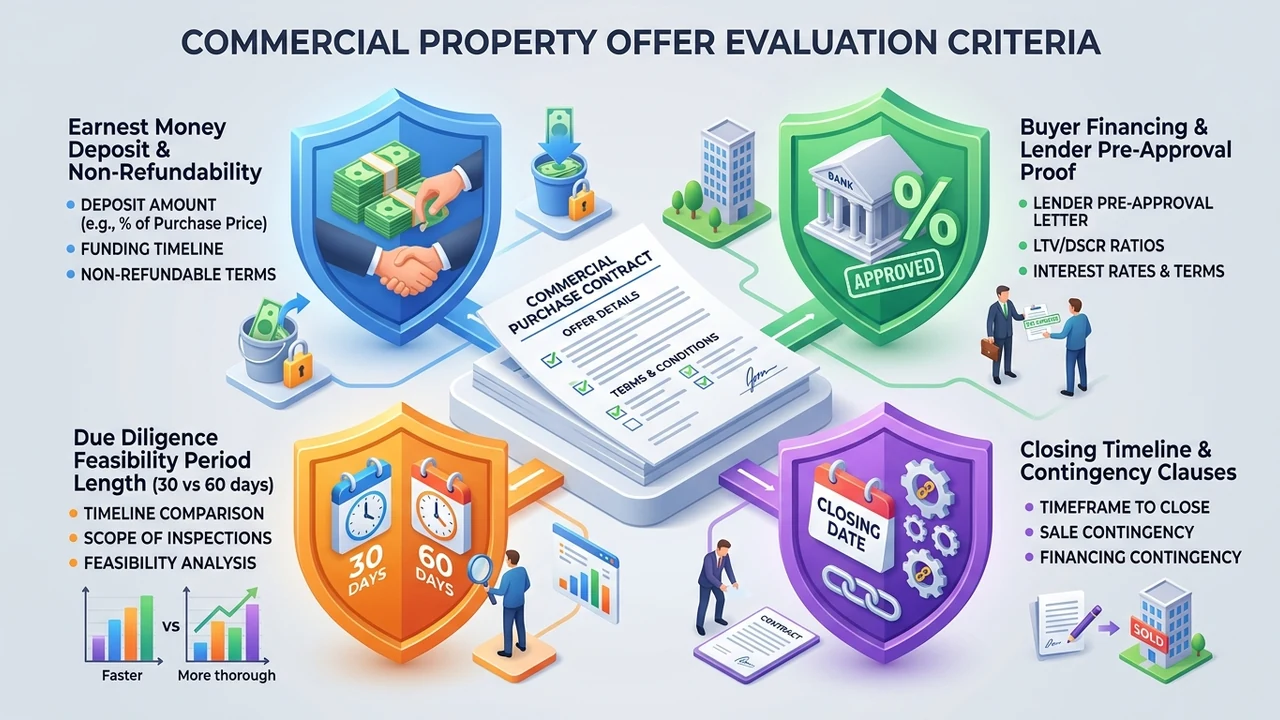
Earnest money is the buyer’s skin in the game. On commercial deals I handle, this deposit usually runs 1% to 5% of the price. A tiny deposit is a yellow flag. It means the buyer can walk and lose almost nothing, while you lost weeks of market time and maybe another good offer.
Here is how I break down the main parts of an offer and what I look for in each:
| Offer term | What it means | What I check for |
|---|---|---|
| Purchase price | The headline number | Is it near true market value, not just high on paper? |
| Earnest money | Buyer’s deposit | Is it large enough (1%–5%) to keep them committed? |
| Contingencies | Buyer’s ways to exit | Are there too many, and how long do they last? |
| Due diligence period | Time to inspect | Is it 30–60 days, not an open-ended stall? |
| Closing date | When money moves | Does it match your plans and taxes? |
| As-is clause | Sold in current condition | Does it limit repair demands later? |
Contingencies are the escape hatches. They let the buyer cancel and get their deposit back if something does not check out. Common ones cover inspection, financing, and the environmental report. A few fair contingencies are normal. A pile of vague ones lets the buyer treat your deal like a free hold while they shop around.
Price itself is still worth a hard look, and it is fair to counter. If you want a clear-eyed read on whether the number matches your market, our guide on how to negotiate a commercial property price walks through the moves that actually work. And to understand which exit clauses help you versus hurt you, this breakdown of commercial real estate contract contingencies is a solid place to start.
The letter of intent is not the finish line
In my professional experience, I’ve found that sellers often treat the letter of intent like a done deal. It is not. A letter of intent, or LOI, is a short paper that lays out the big terms before the full contract. Most of it is not binding. But some parts, like a no-shop promise, can tie your hands for weeks.
Read the LOI for anything that limits you. In the deals I’ve seen go sideways, roughly 1 in 4 problems trace back to a term the seller agreed to in the LOI without reading it closely. A no-shop clause, for example, can stop you from talking to other buyers for 30 to 60 days. That is a long time to sit still.
The LOI sets the tone for everything after it. If the terms here lean hard toward the buyer, the full contract usually follows the same path. So push for fair language now, while it is still cheap to change. Once lawyers start drafting the real deal, every edit costs time and goodwill.
If an LOI just showed up and the wording feels heavy, we can read it with you and flag what actually binds you. For a plain-English primer first, this explainer on the letter of intent in commercial real estate covers what to accept and what to strike before you initial a single page.
What happens to your tenants and leases
If your building has renters, their leases ride along with the sale. The buyer is not just buying brick and land. They are buying your income stream and every promise you made to those tenants. So the offer needs to say clearly how those leases get handled at closing.
Buyers will read every lease closely, and you should too, before you accept. In the properties I review, about 1 in 3 have at least one lease term the owner forgot about: a renewal option, a rent cap, or a repair promise. Any of those can change what the buyer will pay. Surprises here can drop your price late in the game.
Get your lease records clean and ready before the offer stage. Rent rolls, signed leases, and any side letters should match each other. If your paperwork says one thing and your tenant believes another, that gap becomes the buyer’s bargaining chip. Tidy records keep your value where it belongs.
Leases affect price on both sides of a deal, and the logic runs the same way whether you are selling or buying. This guide on how to evaluate tenant leases before a property changes hands shows the exact terms that move a number up or down, so you can spot them before a buyer uses them against you.
Title, zoning, and access problems that stall deals
I’ve seen this pattern many times in my work: the price is agreed, everyone is happy, and then the title search turns up an old lien or a fuzzy property line. Deals freeze. In the closings I’ve been part of, title and survey snags show up in close to 1 out of 3 commercial transactions, and they can add weeks of delay.
Title is proof that you truly own the property and can sell it clean. A buyer wants clear title with no hidden debts, no forgotten easements, and no boundary fights. If an old mortgage, tax lien, or court claim sits on the record, it must be cleared before closing. Sorting this early keeps your deal on track.
Zoning decides what the land and building can legally be used for. If the buyer plans a use your zoning does not allow, the deal can collapse late, and they may blame you. Access matters too. A property with unclear road rights or a shared driveway can scare off a careful buyer fast.
Here in Louisville and across Jefferson County, zoning rules and use approvals are not one-size-fits-all, so it pays to confirm the property’s status early. Pull your survey, your deed, and any recorded easements now. If the buyer’s plan needs a zoning change or special approvals, know that before you promise a fast closing. Clean records and clear rights are what keep a good offer from turning into a stalled one.
Environmental review and why the risk lands on you
Environmental problems are the quiet giant in commercial deals. A careful buyer will order a Phase I environmental site assessment, which is a report that checks whether the land or building has any pollution history. If that report finds trouble, your price and your timeline can both take a hit.
This risk is bigger than most owners think. The U.S. Environmental Protection Agency estimates there are somewhere between 450,000 and 1 million brownfield sites across the country, meaning properties where past use may have left contamination. Old gas stations, dry cleaners, auto shops, and small factories are common examples. Your site may be perfectly clean, but the buyer still needs to confirm it.
Under federal cleanup law, liability can attach based on ownership, not just on who caused the mess. That is why buyers do this homework, and it is why you should know your property’s environmental condition before you accept. If a report finds an issue after you sign, the buyer may demand a price cut, a cleanup, or a full exit.
Get ahead of it. If your property ever held a use that touched chemicals or fuel, expect questions and gather any past reports now. A clean environmental story protects your price. A surprise buried in the soil can undo months of work at the worst possible moment, right before closing.
The money after the sale: taxes, 1031, and net proceeds
In my professional experience, the number that matters most is not the sale price. It is what lands in your bank account after taxes and costs. I’ve watched owners cheer a strong offer, then go quiet when they see the net figure. The gap between the two can be large.
When you sell commercial real estate for a gain, the tax bill can be steep once you add federal capital gains, depreciation recapture, and your state’s share. There is a legal way to push that bill down the road. A 1031 exchange lets you roll your gain into another investment property and defer the tax, but the clock is strict.
The deadlines are not friendly to procrastinators. Under federal law, you must identify a replacement property within 45 days and complete the purchase within 180 days of selling. Miss either date and the tax break is gone. So if a 1031 is part of your plan, you decide that before you accept the offer, not after.
Here are the key 1031 deadlines at a glance:
| Step | Time limit | Starts when |
|---|---|---|
| Identify new property | 45 days | The day you sell (close) |
| Finish buying it | 180 days | The day you sell (close) |
| Hold intent | Investment use | Both properties must be for business or investment |
Closing costs also eat into your check, and sellers usually forget them. In the deals I handle, most owners underestimate their closing costs by a wide margin. Title fees, legal work, transfer taxes, and broker costs all come off the top. To plan the tax move, start with this explainer on the 1031 exchange for commercial property, and to map the deductions from your check, review these closing costs for commercial property in Kentucky. If you want to keep more of your sale, we can plan the tax and net side with you before you sign.
How long the closing will really take
Speed matters more than most sellers expect. Every extra week your deal sits open is a week you cannot fully plan your next move. A cash buyer can close fast. A financed deal usually runs longer because the lender needs an appraisal, inspections, and its own review.
In the transactions I’ve handled, a typical commercial sale takes about 60 to 90 days from a signed contract to a funded closing. Complex deals with zoning questions, lease reviews, or environmental checks can stretch past that. So match the closing date in the offer to what your calendar and your taxes actually need.
A slow buyer is not always a bad buyer, but a vague timeline is a warning. If the offer leaves the closing date open or full of soft conditions, you could wait months and still end up with nothing. Pin down real dates. Tie the deposit to those dates so delay costs the buyer, not you.

Timing in this market has its own rhythm, and local demand plays a big role. If you want a realistic read on the calendar, this piece on how long it takes to sell commercial property in Louisville lines up well with what I see on the ground, and it can help you judge whether an offer’s timeline is fair or fantasy.
Red flags that make me tell a seller to slow down
I’ve solved this problem enough times to know the warning signs by heart. A great price wrapped around bad terms is the trap I see most. When the number looks too good and the contract looks too loose, that is usually not luck. That is a buyer building themselves an easy exit at your expense.
Some red flags show up again and again. In the deals I’ve watched fall apart, a large share tie back to the same handful of issues. A weak deposit, a long list of vague contingencies, or a buyer who cannot prove funds should all make you pause. None of these means walk away. Each means ask more questions first.
Watch for these signals before you sign:
- Tiny earnest money: A deposit under 1% gives the buyer little reason to stay.
- Open-ended due diligence: No end date means they can stall for months.
- No proof of funds: A buyer who dodges this may not be able to close.
- Wobbly financing: Heavy reliance on a loan with no lender letter yet.
- Odd closing date: A date that keeps sliding or has no anchor.
- Too many outs: A stack of contingencies that let them cancel for almost anything.
Honestly, the funny part is that the smoothest deals often come with the plainest offers: fair price, solid deposit, tight timeline, few conditions. When a buyer makes it easy for you to say yes without traps, that is usually the buyer worth trusting. If an offer trips two or more of these flags, we can help you weigh whether to counter, wait, or pass.
Your quick review checklist before you sign
Let me put the whole thing in one simple list you can keep beside the offer. This is the same order I use when a commercial property owner asks me to look at an offer for the first time. Each item is a small gate. If the deal cannot pass a gate, that is where you slow down and ask more.
Run through this before you accept any offer:
- Buyer strength: Proof of funds or a firm lender letter in hand.
- Earnest money: A deposit big enough (1%–5%) to keep them serious.
- Contingencies: Few, clear, and time-limited, not vague and endless.
- Due diligence window: A set period, usually 30–60 days, with a hard end.
- Leases and tenants: Rent rolls and leases match, with no hidden promises.
- Title and zoning: Clear title, correct zoning, and solid access rights.
- Environmental: Known condition, with any past reports gathered.
- Taxes and net: Your after-tax number figured, with a 1031 plan if needed.
- Closing date: A real date that fits your calendar and your next move.
Most owners can work through this list in an afternoon. In my experience, sellers who use a written checklist like this catch at least one costly problem in the offer that they would have missed by reading fast. The list does not slow you down. It keeps you from signing into a trap.
Before you say yes to any offer
I’ve closed enough deals to say this plainly: the smartest sellers treat an offer as the start of a conversation, not the end of one. Price pulls you in. Terms decide what you actually keep. When you check the buyer, the contract, the leases, the title, and the tax side before signing, you turn a hopeful offer into a safe one.
None of this has to feel heavy. Take the offer one line at a time. Confirm the buyer can pay. Read the contingencies. Get your records clean. Know your net number before you celebrate. Do those few things and you protect both your value and your peace of mind through the whole transaction.
Selling commercial real estate is a big move, and you should not have to read every clause alone. If an offer just came in and you want a second set of eyes, we can review the terms with you and point out what to fix before you sign. A short look now can save you real money at closing.
Frequently asked questions
What should I check first when I get an offer on my commercial property?
Start with the buyer, not the price. Ask for proof of funds or a lender letter right away. In my experience, checking buyer strength up front cuts the odds of a dead deal by close to half. A strong number from a buyer who cannot close is worth less than a fair number from one who can.
Can I say no to an offer after I signed a letter of intent?
Usually yes, because most of a letter of intent is not binding. But some parts can bind you, like a no-shop clause that stops you from talking to other buyers for 30 to 60 days. Read the LOI closely before you sign it. The parts that limit you are the parts that matter most.
What if the buyer is using an SBA loan to buy my property?
Expect a slower, more detailed closing. With a common SBA 504 loan, a private lender holds a senior lien covering up to 50% of the project cost, while a certified development company and the buyer cover the rest. That structure adds appraisals, inspections, and paperwork. It can be a solid deal, but build extra weeks into your timeline.
How long does it take to close after I accept an offer?
For most commercial deals I handle, plan on about 60 to 90 days from signed contract to funded closing. Cash buyers can move faster. Loans, zoning questions, lease reviews, and environmental checks can stretch it longer. Tie the deposit to firm dates so delay costs the buyer, not you.
Do I have to pay taxes right away when I sell?
Not always. A 1031 exchange lets you defer the tax by rolling your gain into another investment property, but the clock is tight: 45 days to pick the new property and 180 days to close on it. Decide on this before you accept the offer. Once you close without a plan, the chance to defer is gone.
