

You found a commercial property that looks great on paper. The building is in good shape. The location works. But here’s the thing most buyers miss, the tenant’s lease can make or break your deal. I’ve seen investors lose thousands because they didn’t read a lease carefully before closing. The rent, the terms, the tenant’s rights, all of it affects your cash flow from day one. So before you sign anything, let me walk you through exactly what to look for in an existing tenant’s lease.
Why the Tenant’s Lease Matters More Than the Building Itself
When you buy a commercial property with a tenant already in place, you inherit that lease. Every word in it. You can’t change it. You can’t renegotiate it until it expires. That lease is now your income, and your obligation.
Think of it this way. The building is the shell. The lease is the engine. A beautiful building with a bad lease is a bad investment. About 72% of commercial property value comes directly from the income the lease produces, not the physical structure itself.
I’ve worked with buyers who fell in love with a property’s curb appeal. They rushed through due diligence. Then they discovered the tenant was paying $8 per square foot when market rate was $14. That’s money left on the table for years until the lease expires.
The lease tells you how much money you’ll make, how long you’ll make it, and what could go wrong. If you want to understand how to evaluate commercial property the right way, start with the lease document, not the building tour.
Start With the Lease Term and Expiration Date
In my professional experience, the first thing I check is how much time is left on the lease. A tenant with 5 or more years remaining gives you stable, predictable income. A lease expiring in 6 months? That’s a risk. The tenant might leave.
Lenders care about this too. Most banks want to see at least 3 to 5 years left on the lease before they’ll approve your loan. A short lease term means the bank sees more risk. And more risk means higher interest rates or a flat-out denial.
Look at the original start date and the end date. Check if there are renewal options. A 5-year lease with two 5-year renewal options is very different from a 5-year lease with no renewals. The renewals give you a safety net.
Also check if the tenant has already exercised any renewal options. If they’ve used both renewals, the lease is truly ending at expiration. No extensions possible. You need to plan for that vacancy.
Check the Rent Amount Against Market Rates
Here’s where many buyers get tripped up. The rent on the lease might look good at first glance. But is it actually good compared to what other tenants pay nearby?
If the tenant pays $12 per square foot and the market rate is $18, that’s below-market rent. You’re losing income every month until that lease ends. On a 5,000 square foot space, that’s $30,000 per year in lost potential income.
On the flip side, above-market rent sounds great. But it increases the chance the tenant won’t renew. They’ll find somewhere cheaper when the lease is up. Then you face vacancy costs, which can eat 6 to 12 months of income between finding a new tenant, negotiating, and building out the space.
Pull comparable rental data for similar properties in the same area. Look at what spaces of the same size, condition, and location are leasing for today. If you need help understanding the numbers, a commercial property cash flow analysis will show you exactly where the rent fits in your overall return.
Understand the Lease Type: NNN, Gross, or Modified
I’ve handled deals where a buyer assumed they were getting a triple net lease, only to discover it was a modified gross. That misunderstanding cost them $15,000 per year in expenses they didn’t plan for.
The lease type tells you who pays for what. In a triple net (NNN) lease, the tenant pays property taxes, insurance, and maintenance on top of rent. You collect rent and have very few expenses. It’s the most hands-off ownership structure.
In a gross lease, you pay everything, taxes, insurance, maintenance, utilities. The rent is higher, but your expenses eat into it. Your net income might actually be lower than a NNN lease with cheaper rent.
A modified gross lease falls somewhere in between. The tenant might pay utilities and janitorial, while you handle taxes and insurance. Every modified gross lease is different, so read the exact terms carefully. If you want to compare these structures side by side, here’s a detailed breakdown of NNN vs gross leases for buyers.
Look at Rent Escalation Clauses
In my experience reviewing hundreds of commercial leases, the escalation clause is often the most overlooked section. But it directly controls whether your income grows or stays flat.
A rent escalation clause means the rent goes up over time. The most common type is a fixed increase, something like 3% per year. That’s predictable and protects you against inflation. With inflation running between 2.5% and 4% over the last few years, a 3% annual bump keeps you roughly even.
Some leases tie increases to the Consumer Price Index (CPI). This means rent moves with inflation automatically. Others have step-ups, the rent jumps at specific dates. For example, $10 per square foot in years 1 through 3, then $12 in years 4 and 5.
The worst case? A flat lease with no escalations. If your tenant pays the same rent for 10 years, inflation eats your real income. A dollar today won’t buy the same thing in 2035. Make sure there’s some built-in growth.
Review Tenant Rights and Options
This is where leases get tricky. Tenants often negotiate special rights that limit what you can do as the new owner. You need to know what those rights are before you buy.
Common tenant rights include a right of first refusal, meaning the tenant gets the first chance to buy the property if you ever sell. This can scare off future buyers or slow down your exit. About 35% of commercial leases for anchor tenants include some form of purchase option or first refusal.
Expansion rights let the tenant take over adjacent space if it becomes available. Exclusive use clauses prevent you from leasing other spaces to competing businesses. For example, a coffee shop tenant might have an exclusive use clause that stops you from leasing to another coffee shop in the same building.
Each of these rights affects your flexibility as an owner. They’re not deal-breakers on their own. But you need to know they exist and factor them into your price. If you’re working through your commercial property due diligence checklist, tenant rights should be near the top.
Assess the Tenant’s Financial Health
I’ve seen this pattern many times in my work, a lease looks perfect on paper. Great rent. Long term. Good escalations. But the tenant is barely staying afloat financially. If they can’t pay, none of those terms matter.
Ask for the tenant’s financial statements. Look at their revenue, profit margins, and how long they’ve been in business. A tenant that’s been in the same location for 10+ years and growing is a much safer bet than a startup in their first year of the lease.
Check the rent-to-revenue ratio. For most retail tenants, rent should not exceed 8% to 12% of their gross sales. If a restaurant pays $5,000 per month in rent but only brings in $30,000 in revenue, that’s nearly 17%, a red flag. They may struggle to keep up.
Also look at their payment history. Has the current landlord reported any late payments or defaults? A tenant who pays on time every month for 5 years is gold. A tenant with multiple late payments is a warning sign. You can learn more about vetting tenants in this guide to screening commercial tenants.
Check for Assignment and Subletting Clauses
Assignment means the tenant transfers their entire lease to someone else. Subletting means they rent out part of their space to another business. Both of these affect you as the new owner.
If the lease allows free assignment without your approval, the tenant could hand the lease to a weaker business. You’d still have the same lease terms, but a tenant who might not pay. About 60% of well-drafted commercial leases require landlord consent for any assignment or sublease.
Look for language that says the tenant needs “landlord’s prior written consent, which shall not be unreasonably withheld.” That’s the standard. It gives you the right to review any new party, but you can’t say no without a good reason.
If the lease is silent on assignment, that’s a problem. In many states, silence means the tenant can assign freely. You want clear language that protects your interest in knowing who occupies your building.
Look at Maintenance and Repair Responsibilities
In my professional experience, maintenance clauses cause more disputes between landlords and tenants than almost anything else. Who fixes the roof? Who handles the HVAC system? Who pays when the parking lot needs resurfacing?
A roof replacement on a commercial building can cost $5 to $12 per square foot. On a 10,000 square foot building, that’s $50,000 to $120,000. If the lease says that’s your responsibility as the landlord, you need to factor that into your purchase price.
In a true NNN lease, the tenant handles most of this. But “NNN” doesn’t always mean what people think. Some NNN leases still put structural repairs, roof, foundation, exterior walls, on the landlord. Read the actual words. Don’t assume based on the label.
Check the condition of major systems before closing. If the HVAC is 18 years old and the lease makes it your problem, budget for a replacement. A commercial HVAC system runs $15,000 to $50,000 depending on building size.
Review Default and Termination Provisions
What happens if the tenant stops paying rent? How many days do they get to fix the problem? Can you terminate the lease immediately, or do you have to wait months?
Most leases give the tenant a 10 to 30 day cure period after a default notice. That means even after they miss rent, you wait up to a month before you can take action. Then eviction itself can take another 30 to 90 days depending on your state’s laws.
Look for early termination clauses too. Some tenants negotiate the right to leave early if certain conditions aren’t met, like if their sales drop below a threshold, or if you fail to maintain the property. A co-tenancy clause is common in retail: if the anchor tenant in a shopping center leaves, smaller tenants can terminate or reduce rent.
Understand your remedies as a landlord. Can you recover lost rent for the remaining lease term? Can you keep the security deposit? Does the lease include a personal guarantee from the business owner? A personal guarantee means you can go after the owner’s personal assets if the business defaults, that’s powerful protection.
Don’t Forget the Estoppel Certificate
I’ve handled deals where the seller said one thing about the lease and the tenant said something completely different. The estoppel certificate protects you from that confusion.
An estoppel certificate is a signed letter from the tenant confirming the key facts of their lease. It states the current rent amount, the lease end date, any prepaid rent, security deposits held, and whether the landlord is in default of anything. Once the tenant signs it, they can’t later claim something different.
About 90% of commercial property sales with existing tenants include an estoppel certificate as a closing condition. If the seller won’t get one, that’s a red flag. It might mean the tenant disputes the lease terms or has claims against the landlord.
Request the estoppel early in your due diligence period. Give the tenant at least 10 to 15 days to review and return it. If anything in the estoppel contradicts the lease, you need to resolve that before closing. If you’re still putting together your buying strategy, check out this guide on commercial real estate contract contingencies, it covers how to protect yourself during the process.
How the Lease Affects Your Property’s Value and Cap Rate
In commercial real estate, the property’s value is directly tied to its income. And the income comes from the lease. So when you evaluate the lease, you’re really evaluating the property’s worth.
The cap rate formula is simple: Net Operating Income divided by Purchase Price. If a property produces $100,000 in NOI and you buy it for $1.25 million, your cap rate is 8%. But if the lease is below market, that NOI is artificially low, and the property might actually be worth more once the lease resets.
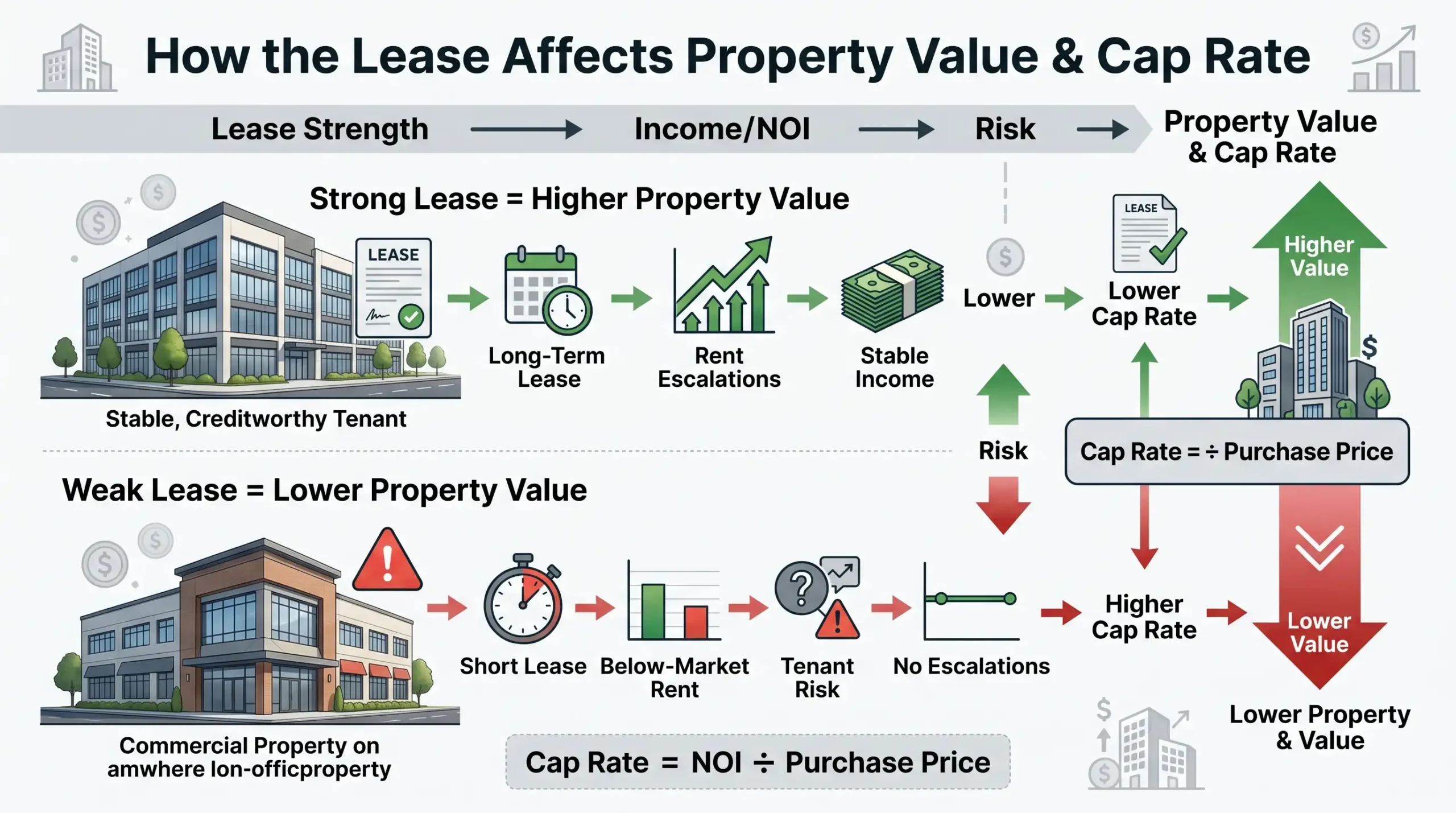
A strong lease with a creditworthy tenant, long term, and built-in escalations will command a lower cap rate, meaning a higher price. Investors pay more for certainty. A weak lease with a shaky tenant and no escalations means buyers demand a higher cap rate (lower price) to compensate for risk.
According to the U.S. Small Business Administration, understanding your income streams and financial commitments is one of the first steps in any business acquisition. The same logic applies when you’re buying a property, the lease IS your income stream. You can learn how cap rates work in detail with this cap rate guide for commercial property.
Red Flags That Should Make You Walk Away
I’ve seen these patterns enough times to know when a deal isn’t worth saving. Here are the warning signs that should make you pause, or walk away entirely:
- A lease with less than 1 year remaining and no renewal options is risky unless you’re buying specifically to re-tenant.
- Below-market rent with no escalation clause means you’re stuck with low income for the full term.
- A tenant with declining revenue may struggle to maintain rent payments.
- Multiple late payments in the last 12 months can be a warning sign of financial instability.
- A tenant’s right to terminate with 30 days’ notice at any time is a major concern. That’s not really a long-term lease; it’s closer to a month-to-month rental dressed up in a long-term contract.
- A cap on operating expense pass-throughs that’s lower than actual costs means you’ll have to absorb the difference every year.
None of these are automatic deal-killers. But each one needs to be reflected in the price you offer. If the seller won’t adjust for lease weakness, move on. There are better deals out there.
Putting It All Together: Your Lease Evaluation Checklist
Evaluating a tenant’s lease isn’t hard. It just takes patience and attention to detail. Start with the basics, term, rent, lease type. Then dig deeper into escalations, tenant rights, and financial health. Finish with the estoppel certificate to confirm everything.
Every piece connects to your bottom line. A long lease with a strong tenant and good escalations means stable, growing income for years. A short lease with below-market rent and a struggling tenant means uncertainty and costs.
If you’re looking at a commercial property in Louisville and need help evaluating the tenant’s lease, reach out to us at Raphael Collazo. We can review the lease terms, compare them to market data, and help you understand exactly what you’re buying. That’s what we do every day.
Frequently Asked Questions
What is the most important thing to check in a tenant’s lease?
The lease term and rent amount. These two things control your income and how long it lasts. A long lease with fair rent gives you stability. A short lease with below-market rent gives you risk and missed income.
Can I change the lease terms after I buy the property?
No. When you buy a property with an existing tenant, you inherit the lease exactly as it is. You cannot change any terms until the lease expires or the tenant agrees to an amendment. This is why reviewing the lease before buying is so important.
What is an estoppel certificate and why do I need one?
An estoppel certificate is a document signed by the tenant confirming the current lease terms, rent amount, expiration date, security deposit, and any claims. It protects you from surprises after closing. If the tenant later says something different, the estoppel holds them to what they signed.
How do I know if the tenant’s rent is at market rate?
Compare the lease rent to what similar spaces in the same area are renting for today. A commercial real estate agent or appraiser can pull comparable data for you. You can also check recent lease comps on commercial listing platforms.
Should I walk away from a property with a below-market lease?
Not always. A below-market lease is a problem if the term is long, you’re stuck with low income for years. But if the lease expires in 1 to 2 years, you can re-lease at market rates soon. Just make sure the purchase price reflects the current below-market income, not what you hope to get later.
