
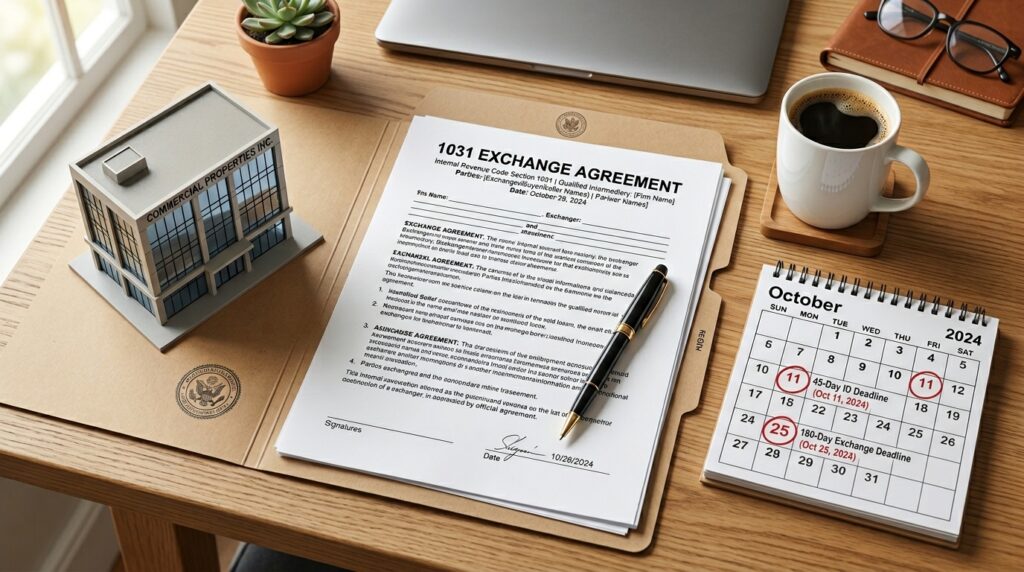
You just sold a commercial building and you’re staring at a huge tax bill that could wipe out a third of your profit. That’s a gut punch. But here’s the good news: the 1031 exchange commercial property rule lets you legally push that tax payment into the future, sometimes forever, so you can reinvest every dollar right away and keep growing.
What Is a 1031 Exchange for Commercial Property?
The Basic Idea in Simple Words
A 1031 exchange is a rule in Section 1031 of the Internal Revenue Code. It lets a real estate investor sell one investment property and buy another like-kind property without paying capital gains taxes right away.
Think of it like a trade-in. You give up your old car at the dealership and get a new one. You do not have to pay the full cost upfront because the trade offsets it. A 1031 exchange works in a similar way. You swap your old commercial property for a new one, and the tax is moved to the future instead of due today.
The name comes from the tax law itself. The IRS wrote Section 1031 to help real estate investors keep their capital working. Instead of losing 20 to 35 percent of profits to federal capital gains tax, state taxes, and depreciation recapture, you roll everything into the next deal.
Who Can Use a 1031 Exchange?
Most people assume this is only for big companies. It is not. Individuals, S corporations, C corporations, LLCs, trusts, and partnerships can all use a 1031 exchange as long as the property is held for business or investment purposes.
What does NOT qualify? Your personal home, your vacation house, or any property you mainly use for yourself. The IRS is very clear that 1031 exchanges are for investment property and business real estate, not personal use.
Quick Example: An investor owns a small office building worth $2 million. She sells it and uses the full $2 million to buy a retail strip center. Because she followed the 1031 exchange rules, she pays zero capital gains tax at the time of sale. Her full $2 million keeps working for her.
How Does a 1031 Exchange Work Step by Step?
The Role of a Qualified Intermediary
Here is where most first-timers get tripped up. You cannot touch the money from the sale, not even for a day.
The moment you sell your relinquished property, the sale proceeds must go to a qualified intermediary, also called a QI or accommodator. This is a third-party company or person who holds the funds on your behalf. The QI then uses that money to buy your replacement property.
I honestly did not understand this part the first time I read about it. I thought, why can’t I just hold the cash myself and promise to reinvest? The IRS says no. If you receive even a dollar of those proceeds directly, the exchange fails and you owe taxes on the full gain. No exceptions.
Your real estate agent, your attorney, or anyone who worked with you on the sale in the past two years cannot act as your QI either. It must be a truly independent third party.
The Two Most Important Deadlines You Must Know
The 1031 exchange has strict deadlines. Missing either one means you lose the tax deferral completely.
| Deadline | Time Allowed | What You Must Do |
| 45-Day Identification Period | 45 calendar days from sale | Submit a written, signed list of replacement properties to your QI |
| 180-Day Exchange Period | 180 calendar days from sale | Close on the replacement property purchase |
These deadlines include weekends and holidays. There are no extensions, no exceptions for market slowdowns, and no grace period. According to the IRS, the identification must be in writing, signed, and delivered to a person involved in the exchange. A quick phone call does not count. (IRS Fact Sheet: Like-Kind Exchanges Under IRC Section 1031)
My honest advice? Start looking for your next property before you even list the one you are selling. The 45-day window flies by faster than you expect, especially in a slow market.
What Properties Qualify for a 1031 Exchange?
Understanding the Like-Kind Rule for Commercial Real Estate
The phrase “like-kind” sounds strict, but in the world of commercial real estate, it is actually very broad. The IRS does not require the two properties to be identical. They just need to be real property held for investment or business use.
This means you can exchange:
An office building for an industrial warehouse. A retail storefront for a multifamily apartment complex. Raw land for a triple net leased property. A shopping mall for a self-storage facility.
What you cannot do is swap your commercial building for a personal vacation home. The key test is always the same: is the new property held for investment or productive use in a trade or business? If yes, it likely qualifies.
A Note on REITs: Real estate investment trusts (REITs) do NOT qualify for 1031 exchanges. The IRS treats REIT shares as personal property, not real property. Keep this in mind when planning your exit strategy.
The Equal or Greater Value Rule
To get a full tax deferral, your replacement property must be worth at least as much as the property you sold. You also need to reinvest all the equity from the sale.
If you sell for $1.5 million and only buy a new property for $1.2 million, the leftover $300,000 is called “boot.” That boot is taxable. Same thing happens if you take on less debt on the new property compared to the old one. Even that difference can trigger a taxable boot.
The math needs to work out cleanly. Most experienced investors plan this out with their CPA or tax advisor months before the sale happens.
What Are the Main Benefits of a 1031 Exchange for Commercial Property?
Tax Deferral and Portfolio Growth
The biggest reason investors use a 1031 exchange is simple: they get to keep more money working for them right now instead of sending it to the IRS.
When you sell a commercial property for a profit, you normally owe federal capital gains tax of 15 to 20 percent, plus net investment income tax of 3.8 percent, plus depreciation recapture tax of up to 25 percent, plus whatever your state charges. In places like California, that state rate alone can be 13.3 percent. Add it all up and you could lose 35 percent or more of your gain in one shot.
A 1031 exchange lets you skip all of that right now. You roll 100 percent of your pre-tax dollars into a bigger, better property. Over time, this compound effect can build serious wealth.
According to a 2024 analysis published by Fidelity Investments, this tax-deferral strategy is one of the most powerful tools available for growing a real estate portfolio while preserving capital. (Fidelity Investments: What Is a 1031 Exchange?)
Estate Planning and the Step-Up in Basis Benefit
Here is something that most people do not talk about enough: what happens when an investor passes away?
When heirs inherit a property that was part of a 1031 exchange, they often receive it with a stepped-up basis. This means the property’s tax basis is reset to its current market value at the time of inheritance. The deferred capital gains tax that was built up over years of exchanging? It can be wiped out completely.
This makes the 1031 exchange not just a tax strategy, but a powerful tool for estate planning and passing wealth to the next generation. For long-term investors, this benefit alone can make the strategy life-changing.
Types of 1031 Exchanges for Commercial Real Estate
Delayed Exchange vs. Simultaneous Exchange
The most common type is the delayed exchange, also called a Starker exchange. This is what most people mean when they talk about a 1031 exchange. You sell your property first and then, within the 45-day and 180-day windows, you find and close on the replacement property.
A simultaneous exchange means both properties close on the same day. This sounds simple in theory, but it is actually hard to coordinate in real life. Both sellers, both buyers, both title companies, and the QI all have to move in perfect sync. Delays happen. Most investors avoid this type unless they already have a buyer and seller lined up ahead of time.
Reverse Exchange and Build-to-Suit Exchange
A reverse exchange flips the normal order. You buy the replacement property first and sell your old property later. This is useful when you find a great deal but your current property has not sold yet. It is more expensive to set up and requires an exchange accommodation titleholder to hold the new property temporarily.
A build-to-suit exchange, also called an improvement exchange, lets you use the sale proceeds to build or improve the replacement property. If you want to buy a piece of raw land and build on it, this type makes that possible while still getting the tax deferral.
Common Mistakes That Kill a 1031 Exchange
Missing Deadlines and Receiving Boot
The number one mistake I have seen people make is underestimating how fast the 45-day clock moves. You close on your sale, life gets busy, and suddenly you only have two weeks left and you have not identified anything. At that point you are scrambling to pick properties just to meet the deadline, which usually leads to bad investment decisions.
The second most common mistake is receiving boot without realizing it. Maybe you negotiated some cash back at closing, or you bought a property with a lower loan balance than the one you sold. That difference is taxable and could wipe out part of your deferral.
Vague property identification is another one. The IRS requires that the properties you identify be described with enough detail to be recognized. Writing “commercial building in Texas” is not enough. You need to include the actual address or legal description.
Failing to Use a Proper Qualified Intermediary
Some investors try to cut costs by using an informal arrangement, maybe a friend who holds the money or a relative who is also a real estate agent. This disqualifies the entire exchange. The IRS is very specific about who can serve as a QI.
Also, be careful when choosing your QI. According to the IRS, there have been cases where intermediaries declared bankruptcy or could not meet their obligations, leaving the investor unable to complete the exchange within the required deadlines. Choose a company with a strong reputation and make sure the funds are held in a separate, insured account.
Conclusion
The 1031 exchange commercial property strategy is one of the smartest tools in a real estate investor’s toolkit. It lets you sell a property, skip the big tax bill for now, and put every dollar to work in your next deal.
The rules are strict: you need a qualified intermediary, you must identify your replacement property within 45 days, and you must close within 180 days. The new property must be like-kind and worth at least as much as what you sold. Get these things right and you can grow your portfolio with pre-tax dollars for years, even decades.
This is not a shortcut or a loophole. It is a legal part of the US tax code designed to encourage real estate investment. Millions of investors have used it to build real wealth, and you can too.
If you are thinking about doing a 1031 exchange, talk to a CPA, a qualified intermediary, and a real estate attorney before you close on any sale. The planning you do before the sale is what makes the difference between a smooth exchange and a costly mistake.
I would love to hear if you have ever done a 1031 exchange or if you are thinking about your first one. Drop your questions below and let’s talk!
Frequently Asked Questions
Can I do a 1031 exchange for any type of commercial property?
Yes, almost any commercial property held for investment or business qualifies. Office buildings, warehouses, retail stores, apartment complexes, raw land, and even triple net leased properties can all be part of a 1031 exchange. The key is that both the property you sell and the one you buy must be held for business or investment, not personal use.
What happens if I miss the 45-day identification deadline?
If you miss the 45-day window to identify your replacement property, the exchange fails. You will owe capital gains taxes on the full profit from the sale of your relinquished property, just as if you had never started the exchange. There are no extensions for this deadline. This is why it is so important to start looking for the next property before you even list the one you are selling.
Can I do multiple 1031 exchanges over my lifetime?
Yes! You can keep doing 1031 exchanges from one property to the next as many times as you want. Every time you exchange, the capital gains tax gets pushed further into the future. Many long-term investors do this throughout their lifetime and never pay the deferred tax because when they pass away, their heirs receive the property with a stepped-up basis, which can eliminate the tax entirely.
Can I exchange a residential rental property for a commercial property?
Yes, you can. As long as both properties are held for investment or business purposes, they qualify as like-kind under the IRS rules. So you could sell a residential rental home and buy a commercial office building or a warehouse using a 1031 exchange. The property type does not have to match exactly. What matters is the purpose behind holding the property.
What is “boot” and how does it affect my 1031 exchange?
Boot is any cash or value you receive from the exchange that you do not reinvest into the replacement property. For example, if you sell for $2 million but only buy a new property for $1.7 million, the $300,000 difference is boot and it is taxable. Boot can also come from a reduction in mortgage debt between the two properties. To fully defer all taxes, your new property must be worth at least as much as your old one and you must reinvest all the equity.
