
Think of the Louisville Property Investment Performance Index like a report card for the city’s real estate market. It measures things like home price appreciation, rental income, vacancy rates, cap rates, and cash flow potential. Together, these numbers tell you how healthy the market is and whether it is worth investing in.
Investors use this kind of index to compare cities and decide where to put their money. Right now, Louisville is scoring well across almost every metric. It is not the flashiest market in the country, but it is one of the most reliable ones. And honestly, that is exactly what most investors want.
Why Investors Are Watching Louisville Right Now
Louisville has a quality that many big markets have lost: affordability with real growth. The median home price in the city finished 2025 at $288,500 year-to-date, a 4.5% increase over the prior year. The average sale price rose 5.5% to $346,519. These are not wild numbers, but they are steady and going in the right direction.
What makes Louisville interesting is that it is a large, mature market. It is not a tiny city chasing fast growth. It is a metro area of over 1.39 million people that keeps growing year after year. That size means more stability. And stability is something every long-term investor loves.
I have talked to several investors who ignored Louisville for years because it did not seem exciting. Then they watched their “exciting” markets cool off while Louisville just kept moving forward. That taught them something important: boring can be very profitable.
Key Numbers That Shape the Index
Here is a quick look at the most important data points for 2025:
| Metric | 2025 Value |
| Median Home Sale Price (YTD) | $288,500 (+4.5% YoY) |
| Average Sale Price | $346,519 (+5.5% YoY) |
| Average Rent | $1,218–$1,233/month |
| Rent Growth (Annual) | 2.5% |
| Multifamily Vacancy Rate | ~6.2%–8.9% |
| New Units Delivered in 2025 | ~1,286–1,290 |
| Mortgage Rate Forecast | 6.2%–6.5% |
| Days on Market (Average 2025) | 46 days |
| List-to-Sale Price Ratio | 98.4% |
These numbers show a market that is healthy and balanced. Sellers are still winning on price. Buyers have more options than before. And investors are finding solid cash flow and long-term appreciation in one place.
Home Prices and Appreciation Trends in 2025
The Louisville housing market showed real strength all through 2025. New listings went up 12.5% year-over-year, reaching 22,904 homes for the full year. That is good news for buyers who had been shut out by low supply. Total closed sales came in at 15,192, up 3.3% from 2024, showing that buyer demand stayed firm even as more homes came to market.
How Louisville Median Sale Prices Have Moved
Prices in Louisville follow a clear seasonal pattern. They peak in the summer and cool a little in the fall and winter. In June 2025, the median sale price hit $307,000, a 5.9% jump from the prior year. By October 2025, it had come back down to around $297,500, which is totally normal for this time of year.
According to data reported by the Greater Louisville Association of Realtors (GLAR) via The Lane Report, the market is moving toward what experts call “sustainable balance.” Inventory jumped 34% year-over-year in some months. More homes for sale means buyers have more choices and prices do not overheat.
“We’re seeing encouraging signs of both supply and demand growing in tandem,” GLAR President Will Fischer said. That kind of balance is rare and very good for investors who want to buy without overpaying.
Neighborhood Trends: Where Values Are Growing Fastest
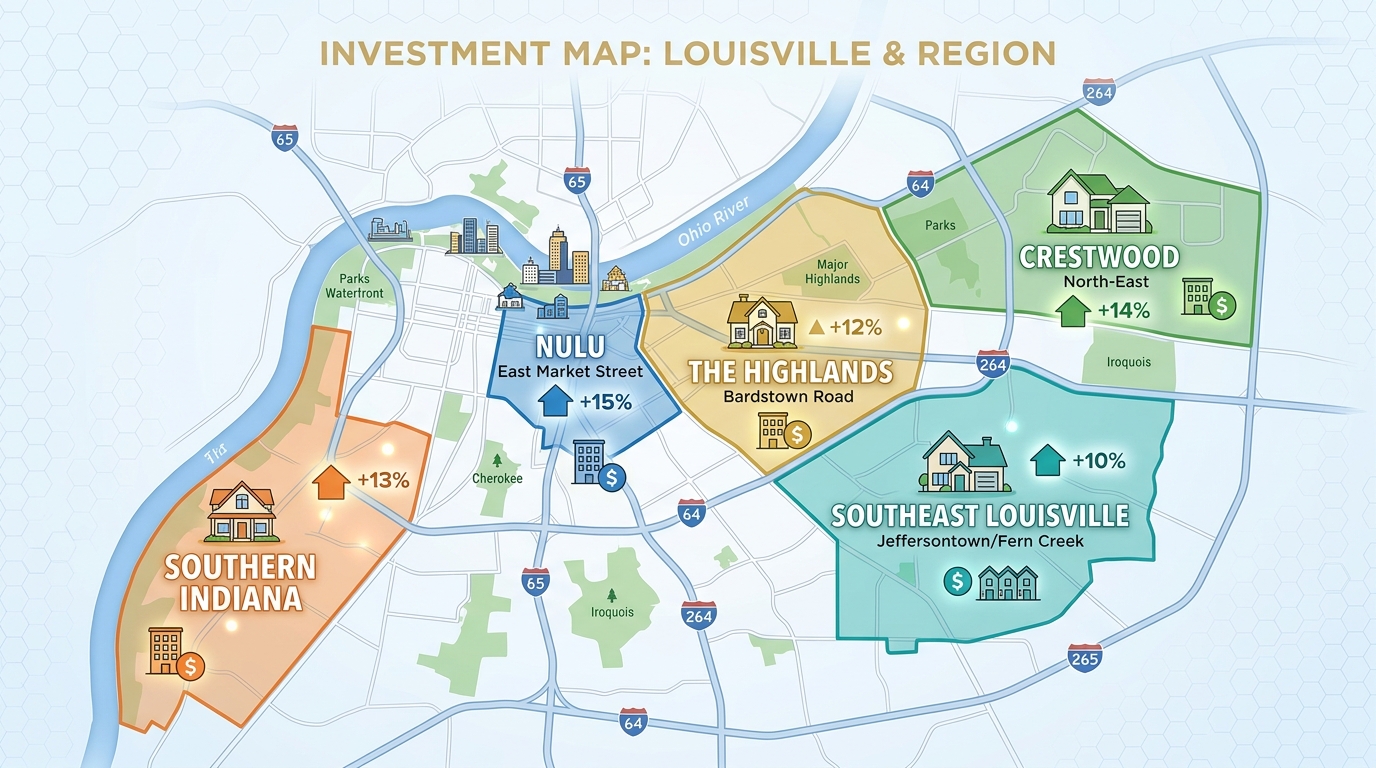
Not every part of Louisville grows at the same pace. Some areas are clearly outperforming the rest. NuLu and The Highlands have seen big value increases in 2025. These neighborhoods attract young professionals and families who want vibrant city life close to food, art and entertainment.
The median sale price per square foot across Louisville rose by 4.8% this year. That shows the whole market is healthy, not just a few hot spots. Crestwood, in the northeastern part of the city, is known for its suburban feel and diverse housing options. It is great for families and long-term buy-and-hold investors.
Southeast Louisville and Southern Indiana (part of the greater Louisville metro) also stand out. Southern Indiana has some of the highest population growth in the metro area. That growth brings more renters and more demand for housing. If you are looking for a place where your investment will keep rising, these neighborhoods deserve serious attention.
Rental Market Performance and Vacancy Rates
If you ask me what the single best reason to invest in Louisville right now is, I would say the rental market. It is growing steadily, staying affordable, and showing no signs of slowing down. That is a rare combination.
Average Rent Growth and What It Means for Landlords
The average effective rent in Louisville reached $1,218 to $1,233 per month by the end of 2025. That sounds modest compared to cities like Nashville or Denver, but that is actually a huge advantage. Louisville’s lower rents attract renters who are leaving higher-cost cities. More renters mean more demand. More demand means landlords hold pricing power.
According to a 2025 market forecast published by MMG Real Estate Advisors, rent growth in Louisville is projected to reach 2.5% annually by year-end 2025. That outpaces the national benchmark of 1.1%. For landlords, that means more income each year without having to do anything extra.
Louisville also ranked No. 1 in the nation for rent growth in Q2 2024, according to Apartments.com data. That kind of recognition does not happen by accident. It happens when the fundamentals are right.
Multifamily Supply Drop: The Big Story for 2025
Here is what I think is the most important story in the entire Louisville Property Investment Performance Index 2025: new supply is dropping fast. Multifamily construction starts fell 69% year-over-year between 2023 and 2024, going from 3,499 units to just 1,068 units. In 2025, only about 1,286 to 1,290 new units are expected to come online. That is the lowest level in eight years.
When supply drops, but demand stays strong, occupancy goes up, and rents go up. That is basic economics. And it is working exactly like that in Louisville right now. Net absorption in 2024 exceeded the historical average at 2,255 units and is expected to stay strong in 2025. That means more units are being filled than left empty.
The occupancy rate in Louisville’s multifamily sector sits at around 93.7% to 93.8%. That is equal to the national benchmark, but Louisville’s rate is well above its early 2020 low of 92.8%. As the new supply keeps shrinking, occupancy is only going to improve.
When I look at all this data together, multifamily is clearly the strongest play in Louisville right now. Less competition from new buildings, more renters to fill your units, and rents that keep climbing. That combination is hard to find anywhere else.
Cap Rates, Cash Flow, and Return on Investment
Numbers are everything in real estate investing. You need to know what you are getting before you sign anything. Let me walk you through what the Louisville Property Investment Performance Index 2025 shows about returns.
What Cap Rates Look Like in Louisville Today
A cap rate (capitalization rate) tells you how much income a property makes compared to its price. A higher cap rate usually means a better return. In Louisville, traditional rental cap rates currently range from about 5.76% to 11.04%, depending on the property type and location. That is a healthy range. It shows that the right properties in the right spots are generating high income.
Short-term rental properties on platforms like Airbnb are showing cap rates as high as 9.63% in some parts of the city. That is impressive for a mid-size metro. If you know what you are doing with short-term rentals, Louisville can be very rewarding.
According to research published by The Kirkland Company, average operating expenses for multifamily properties in Louisville come in at around $5,653 per unit annually. That helps investors model their cash flow before buying, so there are no surprises after closing.
Best Property Types for Cash Flow in 2025
Not all property types perform the same way. Here is what the data shows for 2025:
Multifamily rentals are the top pick right now. Low supply growth, strong renter demand, rising rents, and healthy occupancy all point in the same direction. If you can find a good multifamily deal in Louisville, the cash-on-cash return can be very attractive.
Single-family rentals in areas like The Highlands and Southeast Louisville continue to offer steady income and long-term property value appreciation. These are great for investors who want something simpler to manage.
Short-term rentals like Airbnb properties work well in areas close to downtown, bourbon trail attractions, and event venues. Louisville draws millions of visitors each year. The city posted a record $4.4 billion in tourism revenue for 2024, with over 90% of visitors returning multiple times. That creates strong demand for short-term stays.
A friend of mine bought a two-bedroom property near downtown Louisville a couple of years ago and listed it on Airbnb. He was nervous at first because he had only done long-term rentals before. Within six months, he was earning more than he would have from a traditional tenant. Louisville’s tourism and event calendar made all the difference.
Louisville’s Economic Engine: Why the Market Stays Strong
You cannot understand the Louisville Property Investment Performance Index 2025 without understanding the city’s economy. Real estate does not grow in a vacuum. It grows because people want to live and work in a place. And Louisville gives them plenty of reasons to do both.
Jobs, Industry, and Population Growth
Louisville is not a one-trick town. Its economy is built on multiple industries: healthcare, logistics, manufacturing, bourbon, tourism, and professional services. That diversity protects the city when one sector slows down. Other sectors pick up the slack.
The Louisville MSA GDP reached $97.7 billion by the end of 2024. The city is home to two major Ford assembly plants employing over 12,500 workers. GE Appliances employs 8,400 people at its Appliance Park campus. UPS Worldport, the largest fully automated package-handling facility in the world, supports over 90,000 logistics jobs across the metro. That is nearly 10% of total employment in the area.
New investment is also coming in fast. Foxconn is investing $174 million into a new Jefferson County manufacturing plant. GE Appliances is reshoring manufacturing from China to Louisville, adding 800 jobs. Norton Children’s Hospital announced a new $1 billion-plus pediatric campus in Jeffersontown that will add 1,000 jobs. These are not small announcements. These are generational investments that will support population growth and housing demand for years.
Since March 2020, the Louisville metro has added over 40,000 jobs. That kind of post-pandemic recovery shows a strong labor market. Strong labor markets mean more people who can pay rent and buy homes. That is the engine behind every number in the Louisville Property Investment Performance Index.
Why Louisville Beats Many Other Investment Markets
Most guides will tell you to chase the hottest market. But from what I have seen, the smartest investors look for markets that are stable, affordable, and growing for the right reasons. Louisville checks every one of those boxes.
Compare Louisville to cities like Nashville or Charlotte. Those markets are exciting, but prices have jumped so high that cash flow is hard to find. In Louisville, you can still buy a property at a reasonable price, rent it out at a competitive rate, and make real money. The math still works here.
The city’s home prices remain well below the national average, even after several years of appreciation. That affordability keeps attracting new residents from higher-cost areas. More residents mean more renters. More renters mean more income for investors. It is a cycle that keeps feeding itself.
Louisville is also very landlord-friendly. Property taxes are low by national standards. Rental regulations are reasonable. And the city has a strong history of respecting property rights. All of that matters when you are building a long-term real estate investment portfolio.
Conclusion
The Louisville Property Investment Performance Index 2025 points in one clear direction: this is a strong market for investors who think long-term. Home prices are rising at a healthy pace. Rents are growing faster than the national average. New supply is shrinking. The local economy keeps adding jobs and attracting major investment. And the city remains far more affordable than most comparable markets.
You do not need to find the next boom town. You need to find a market that works quietly and reliably, year after year. Louisville does exactly that. Whether you are looking at single-family rentals, multifamily properties, or short-term Airbnb investments, the data support making your move in 2025 and into 2026.
I would love to hear your thoughts. Are you already invested in Louisville? Or are you just starting to look? Drop a comment below and share what you are seeing in the market.
Frequently Asked Questions (FAQs)
1. What is the Louisville Property Investment Performance Index 2025?
The Louisville Property Investment Performance Index 2025 is a way to measure how well real estate is doing in the Louisville metro area. It looks at home price appreciation, rental income, vacancy rates, cap rates and cash flow potential. Investors use this data to decide if Louisville is a good market for buying property. In 2025, the index shows strong fundamentals across almost every category, making Louisville one of the more reliable investment markets in the U.S.
2. Is Louisville a good place to invest in real estate in 2025?
Yes. Louisville offers a rare mix of affordability, steady price appreciation, strong renter demand, and a diverse economy. The median home sale price finished 2025 at $288,500, up 4.5% from last year. Average rent grew at 2.5% annually, beating the national average. New housing supply is at its lowest level in eight years. All of these things together create a very favorable environment for both short-term and long-term real estate investors.
3. What are the best neighborhoods to invest in Louisville in 2025?
Some of the best neighborhoods for real estate investment in Louisville in 2025 include The Highlands, NuLu, Southeast Louisville, Crestwood, and Southern Indiana (part of the greater Louisville metro). These areas show strong property value appreciation, high rental demand, and growing populations. NuLu and The Highlands attract young professionals. Crestwood is great for families. Southern Indiana has some of the highest population growth in the entire metro area.
4. What are typical cap rates for investment properties in Louisville?
In 2025, traditional cap rates for Louisville investment properties range from about 5.76% to 11.04%, depending on the property type and neighborhood. Airbnb and short-term rental properties in the right areas can show cap rates as high as 9.63%. These are healthy returns compared to many other U.S. cities. The key is to research specific streets and blocks before buying, since cap rates can vary a lot even within the same zip code.
5. How is the Louisville rental market performing in 2025?
The Louisville rental market is performing well in 2025. Average effective rent reached around $1,218 to $1,233 per month by year-end. Rent growth came in at 2.5% annually, which beats the national benchmark of 1.1%. The multifamily occupancy rate sits at 93.7% to 93.8%. New supply of rental units dropped to its lowest level in eight years, with only about 1,286 new units expected in 2025. That shrinking supply combined with strong renter demand, puts upward pressure on rents and keeps vacancy rates low, which is great news for landlords.
