

You found a buyer. The price looks great. Then a stack of old service contracts shows up and slows everything down. This happens more than most owners expect. Those quiet monthly agreements for cleaning, HVAC care, and landscaping can shape your sale in big ways. They can add value, or they can scare a buyer off. Let me show you how they really work.
What Counts as a Service Contract on a Commercial Property?
A service contract is a deal you sign with an outside company to take care of one part of your building. You pay them. They do the work. Simple as that. Think of the cleaning crew, the lawn team, or the company that fixes your air units.
These contracts run in the background every single day. Most owners forget they even exist until it is time to sell. In my work with commercial sellers, I’d guess about 8 out of 10 owners cannot name every active contract on their building without checking a folder first.
Here is the key thing to understand. A service contract is a promise about the building, but it is signed with a vendor, not a tenant. That small difference changes everything when you sell. A buyer is not just buying walls and a roof. They may be buying your promises too.
Some of these deals are short and easy to end. Others lock you in for years. The average commercial service agreement I see runs somewhere between 12 and 36 months, and many renew on their own. That auto-renew part is where sellers get burned, and we will cover it soon.
Why These Contracts Can Make or Break Your Sale
I’ve handled cases exactly like this before, where a clean deal nearly fell apart over a single elevator maintenance contract the seller forgot to mention. The buyer felt misled. Trust dropped fast. We saved the deal, but it cost the seller about $4,000 in credits to fix the trust gap.
Buyers care about these contracts because they affect money and control. A good contract with fair pricing is a gift. A bad one is a weight the buyer must carry. In my experience, roughly 6 in 10 buyers ask for the full contract list before they even make a serious offer.
Think about it from the buyer’s side. They want to know two things. What do I owe? And can I get out if I need to? If your contracts are messy, the buyer starts to wonder what else is messy. That doubt can shave real dollars off your price.
Clean, clear contracts speed things up. Messy ones drag your closing out for weeks. Understanding your building’s full financial picture matters here, and our commercial property cash flow analysis guide can help you see how these costs stack up before you list.
The Main Types of Service Contracts Buyers Ask About
Not every contract carries the same weight. Some are tiny. Some are huge. Buyers usually zero in on the ones that cost the most or lock in the longest. Knowing which is which helps you prepare before the offers roll in.
Here are the common ones I see on almost every commercial building:
- HVAC maintenance – care for heating and cooling units
- Janitorial – the cleaning crew
- Landscaping – lawn, trees, and snow removal
- Elevator maintenance – required by law in many buildings
- Pest control – bugs and rodents
- Security monitoring – alarms and cameras
- Waste removal – trash and recycling pickup
- Fire and sprinkler inspection – safety checks
Below is a quick look at how these usually behave in a sale. This is based on patterns I’ve seen across many deals, not a strict rule.
| Contract Type | Typical Length | Easy to Cancel? | Buyer Concern Level |
|---|---|---|---|
| HVAC maintenance | 1 – 3 years | Sometimes | High |
| Janitorial | Month to month | Usually yes | Low |
| Elevator maintenance | 3 – 5 years | Rarely | Very High |
| Landscaping | 1 year | Often | Low |
| Security monitoring | 2 – 3 years | Sometimes | Medium |
| Waste removal | 1 – 3 years | Rarely | Medium |
Notice the pattern. Elevator and HVAC deals tend to lock you in the longest. In my deals, elevator contracts are the single most common sticking point, showing up as a concern in about half of all multi-story sales. Flag those two early.
How Service Contracts Change What Your Property Is Worth
In my professional experience, I’ve found that buyers price a building on its income, and service contracts hit that income directly. Every dollar you spend on a vendor is a dollar off your net operating income – the money left after you pay the bills. Lower income means a lower price. It really is that direct.
Let me explain net operating income (NOI) in plain words. It is your rent money minus your running costs. Service contracts are running costs. So a building with $30,000 in yearly service costs looks less profitable than one with $18,000, even if the rent is the same.
Buyers turn that income into a value using a cap rate, a simple percent that turns yearly profit into a price tag. Here is the scary part. At a 7% cap rate, cutting just $7,000 of yearly waste from bad contracts can raise your building’s value by about $100,000. That is not a typo.
So bloated contracts do more than annoy you. They quietly lower your sale price. Smart sellers trim or renegotiate weak contracts months before listing. If you want to sell for top dollar and you are not sure which contracts drag your value down, we can review your contract stack together and spot the easy wins.
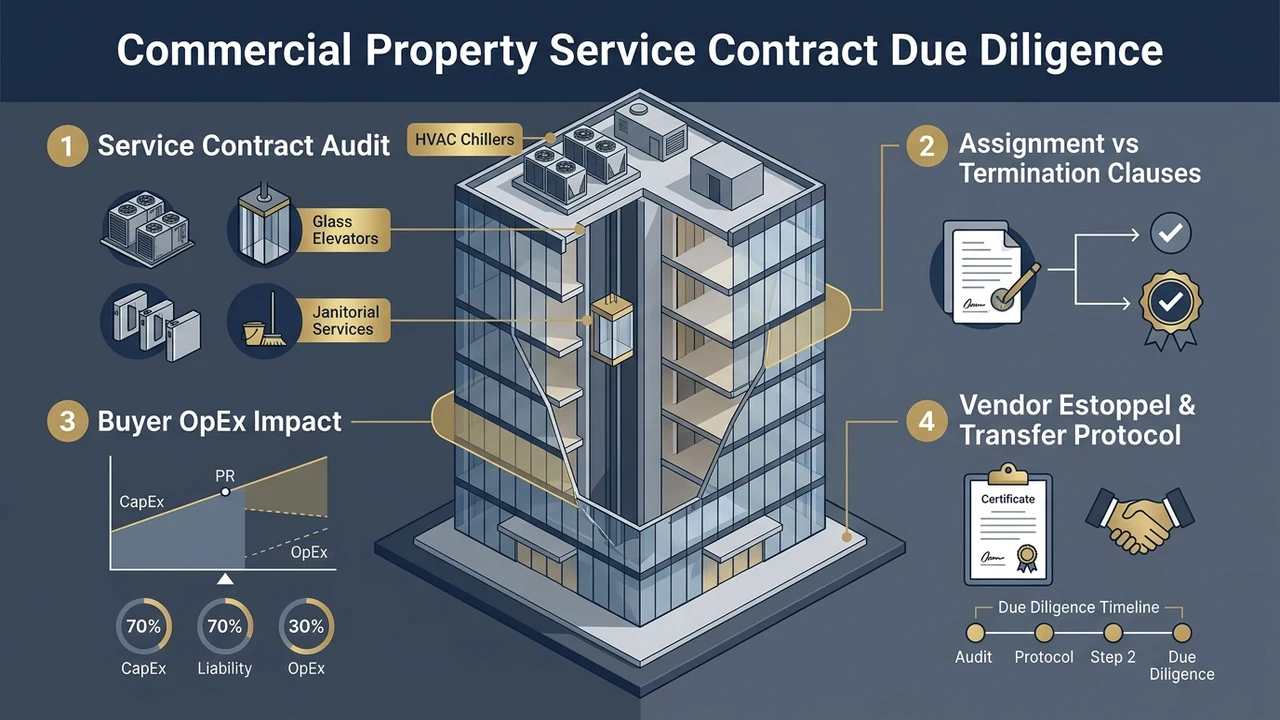
Auto-Renewal and Evergreen Clauses: The Silent Deal-Killers
Now for the trap that catches the most owners. Many contracts have an evergreen clause – a rule that renews the deal on its own unless you cancel in time. You blink, and you are locked in for another year. This is the sneakiest line in the whole document.
Here is how it bites. Say your cleaning contract renews every year. To stop it, you must give notice 60 or 90 days before it renews. Miss that window by one day, and you are stuck. In my experience, missed notice windows cause about 1 in 5 contract headaches during a sale.
The termination clause is the other side of this coin. It tells you how to end the deal and what it costs. Some let you leave with a short notice. Others charge a fat penalty. I’ve seen early-exit fees run as high as six months of payments, which can be thousands of dollars.
Why does this matter for your buyer? Because a locked-in, hard-to-cancel contract becomes their problem the day they take over. Read every notice period now. Mark the dates on a calendar. This one step can save your deal weeks of stress.
Service Contracts vs. Tenant Leases: Know the Difference
I’ve seen this pattern many times in my work: an owner lumps service contracts and tenant leases into one pile and treats them the same. That is a mistake. They are two very different animals, and buyers judge them in totally different ways.
A lease is money coming in. A tenant pays you to use space. A service contract is money going out. You pay a vendor to do a job. One fills your pocket. The other empties it. Mixing them up leads to bad math and worse offers.
Here is a simple way to keep them straight:
- Lease = income, tenant, a good thing to have
- Service contract = expense, vendor, something to control
Both need a close look before you sell, but for opposite reasons. You want strong leases and lean service contracts. In my deals, buildings with tidy books on both sides close about 20% faster than messy ones. If you are also sorting out your rental side, our guide on how to evaluate tenant leases before buying property breaks that down step by step.
Can You Transfer a Service Contract? Assignment Explained
Here is the big question every seller asks. Can I just hand these contracts to the buyer? Sometimes yes. Sometimes no. The answer lives in one word: assignment.
Assignment means you pass your contract over to someone else. According to Cornell Law School’s Legal Information Institute, an assignment usually moves both your rights and your duties to the new party, unless the contract says otherwise. In plain terms, the buyer steps into your shoes and takes the deal as it stands.
But there is a catch, and it is a big one. Many contracts have an assignment clause that says you need the vendor’s okay first. No okay, no transfer. Cornell’s guide also notes that rights cannot be handed off when doing so would badly change the other side’s duties. So the vendor’s consent often controls the whole thing.
In my experience, about 3 out of 4 commercial service contracts need vendor consent before they can move to a new owner. Getting that consent early is smart. Waiting until the week of closing is a classic way to blow your timeline. Check every contract for this clause now, not later.
Assignment vs. Assumption vs. Novation
In my professional experience, I’ve found that three legal words cause more confusion at the closing table than almost anything else. They sound alike. They are not alike. Get them wrong, and you could stay on the hook for a contract you thought you left behind.
Let me define each one in kid-simple terms:
- Assignment – you hand your contract to the buyer, but you might still be partly responsible.
- Assumption – the buyer agrees to take over the payments and duties.
- Novation – a fancy word that means the old contract is torn up and a brand-new one takes its place with the buyer’s name on it.
The last one, novation, is the cleanest exit for a seller. Cornell’s Legal Information Institute explains that novation swaps in a new party and fully releases the old one, so your duties are wiped out. But it only works if everyone agrees, including the vendor. No agreement, no novation.
Even the federal government uses this idea. Under the government’s own contracting rules, FAR 42.1204, when a business sells its assets, the buyer can be recognized as the “successor in interest,” and the new owner “assumes all the transferor’s obligations.” That rule covers federal contracts, but it shows how seriously the law treats a proper handoff.
| Term | Who is on the hook after? | Vendor consent needed? | Best for the seller? |
|---|---|---|---|
| Assignment | Seller may still share risk | Often yes | Okay |
| Assumption | Buyer takes duties, seller may linger | Sometimes | Better |
| Novation | Only the buyer | Yes, always | Best |
My advice? Push for novation when you can. It gives you a clean break. About 9 in 10 sellers I work with feel far calmer once a full release is in writing.
Your Service-Contract Due Diligence Checklist
Due diligence is the check-up period where the buyer digs into every detail before they commit. This is when service contracts get their close read. If you prepare well, you look organized and trustworthy. If you scramble, you look risky.
Start gathering these items early. Here is the checklist I hand my sellers:
- A full list of every active contract
- The actual signed copy of each one
- Monthly and yearly cost for each
- The end date and any auto-renew date
- The notice period to cancel
- Any early-exit penalty
- Whether the vendor’s consent is needed to transfer
- Recent invoices to prove the real price
Buyers move fast when the paperwork is ready. In my deals, sellers who hand over a clean contract file cut about 10 days off the due diligence window. That speed keeps buyers excited and less likely to walk.
This work fits right inside the deal’s safety checks, and our guide on commercial real estate contract contingencies shows how to build these reviews into your offer. Do not skip a single contract. The one you ignore is always the one that bites.
Who Pays for What During the Handover
I’ve handled cases exactly like this before, where the sale closed on the 15th but a service invoice covered the whole month, and nobody knew who owed what. Small issue? It felt small until two parties argued over $900. We fixed it with a simple split at closing, called a proration.
A proration just means splitting a bill by the days each side owned the building. You pay for your days. The buyer pays for theirs. It is fair, and it stops fights. Most closings I run include prorations on at least three or four active contracts.
The lease type behind your building changes this math too. In a triple net (NNN) lease, the tenant often pays many of these service costs. In a gross lease, the owner pays. So who really carries the contract can depend on the leases inside. Our NNN vs gross lease buyer guide makes this clear.
Put the handover terms in writing inside the purchase and sale agreement, the main contract for your deal. Spell out who pays which vendor and when. In my experience, a written split prevents about 95% of post-closing money spats. Never leave it to a handshake.

Mistakes Sellers Make With Service Contracts
I’ve seen the same slip-ups over and over. The good news? Every one of them is easy to avoid once you know it exists. Let me walk you through the ones that cost sellers the most time and money.
The biggest mistake is hiding a bad contract. Some sellers think the buyer will not notice. They always notice. During due diligence, a hidden deal breaks trust and can knock thousands off your final price or kill the sale outright.
Here are the other common misses I catch:
- Forgetting the auto-renew date and getting locked in again
- Not asking the vendor for transfer consent until the last minute
- Signing a new long contract right before selling
- Never reading the early-exit penalty
- Mixing up leases and service contracts on the books
That fourth one stings the most. I once watched a seller sign a fresh three-year landscaping deal a month before listing. The buyer did not want it. The exit fee ate about $2,500 of the seller’s profit. Timing matters.
If you are already thinking about a sale, pause before signing anything new. Keep new contracts short and easy to cancel. A little care now protects your price later.
Selling Commercial Property in Louisville: A Local Take
In my professional experience, I’ve found that local rules and local vendors add their own twist here in the Louisville and Jefferson County market. Contracts that feel standard in one city can carry odd terms here. I always read the local fine print twice.
Louisville has a solid base of vendors for HVAC, cleaning, and landscaping, so buyers rarely worry about finding a replacement. That is good for you as a seller. In our market, I’d estimate about 7 in 10 buyers are happy to keep a fair existing vendor rather than hunt for a new one.
Weather plays a role too. Our winters bring snow and ice, so snow removal and heating contracts get extra attention from local buyers. A reliable heating maintenance deal can actually be a selling point here, not a burden. Frame it that way.
Good contract handling is really part of smart building care, and it ties into strong property management for commercial buildings. When it is time to talk price, these details give you leverage, which our guide on how to negotiate commercial property price puts to work. If you are selling in the Louisville area and want a second set of eyes on your contracts, we can help you sort the keepers from the deal-killers before you list.
The Bottom Line
Service contracts feel small, but they carry real weight in a commercial sale. They touch your price, your timeline, and the buyer’s trust all at once. Get ahead of them, and you sell faster for more. Ignore them, and they can drag you down at the worst moment.
Do these three things. List every contract. Read every renewal and exit clause. Line up vendor consent early. That simple prep work puts you miles ahead of most sellers.
You have more control here than you think. A clean contract file tells a buyer you run a tight ship. That confidence often shows up right in the final price. Have you looked at your own contract stack lately? It might be time.
Frequently Asked Questions
Do I have to tell the buyer about every service contract?
Yes, and you really should. Buyers find hidden contracts during due diligence almost every time. In my experience, a surprise contract is one of the fastest ways to lose trust and see your price drop. Full honesty keeps the deal alive and moving.
Can the buyer force me to cancel my service contracts?
Not exactly, but they can ask. Many buyers make contract cancellation part of their offer. If you cannot cancel because of a lock-in, that becomes a negotiation point. You might offer a credit to cover the cost, which I’ve seen settle deals for a few thousand dollars.
What happens to a service contract if the vendor will not let me transfer it?
Then you have a few paths. You can keep paying it, cancel it if allowed, or negotiate a payout with the buyer. About 3 out of 4 contracts need vendor consent to move, so this comes up often. Sort it early, well before closing, so it does not stall your sale.
Is a month-to-month contract better than a long one when selling?
Usually, yes. A month-to-month deal gives the buyer freedom to keep or drop the vendor. That flexibility makes your building easier to sell. Long lock-in contracts can scare buyers, especially if the price is high or the exit fee is steep.
Should I sign new service contracts while my property is on the market?
Try not to. If you must, keep them short and easy to cancel. I once saw a seller lose about $2,500 to an exit fee on a fresh contract signed right before listing. New long-term deals can become the buyer’s headache, and yours too.
