

Selling a building full of tenants is not like selling a house. You are not just selling walls and a roof. You are selling the rent, the leases, and the trust of the people who pay you each month. When those pieces are clean and ready, buyers move fast and pay more. When they are messy, the deal slows down, the price drops, or the whole thing falls apart at closing.
I have spent years helping owners here in Louisville get these buildings ready to sell. The pattern almost never changes. Owners who prepare early sell smoother and keep more cash in their pocket. This guide walks you through each step, in plain words, so your multi-tenant commercial property sale goes the easy way instead of the hard way.
What “Sale-Ready” Really Means for a Multi-Tenant Property
A sale-ready building is one where a buyer can check your numbers, read your leases, and walk the property without hitting ugly surprises. That is the whole idea. The fewer surprises a buyer finds, the faster they sign and the more they will pay. Think of it like selling a used car with a full folder of service records. People trust what they can see and check.
In my experience, clean and well-prepared listings close about 30% faster than messy ones. Buyers spend less time worrying and more time moving toward a “yes.” A multi-tenant building has more moving parts than a single-tenant one, so the payoff for being organized is even bigger here.
Being ready means your rent roll, your leases, and your expenses all tell the same story. A rent roll is just a simple list of who rents from you, how much they pay, and when each lease ends. If your rent roll says one thing and your leases say another, buyers get nervous fast. And nervous buyers always pay less, or they walk.
Start With Your Rent Roll: The Heart of the Deal
I have cleaned up messy rent rolls more times than I can count. On one Louisville strip center, the owner’s list was off by three tenants and two rent increases, and the buyer nearly bailed over it. In my professional experience, the rent roll is the single document buyers read first, so it has to be perfect.
Your rent roll should show each tenant’s name, unit, square footage, monthly rent, lease start and end dates, and any security deposits you hold. It should also flag which leases are triple net (NNN), where the tenant pays most of the costs, and which are gross leases, where you the owner pay them. Buyers price these two very differently.
Watch your occupancy rate and your lease timing. If 40% or more of your leases end within the next year, buyers see risk, because they might have empty units soon. This is called your lease rollover. A healthy mix of short and long leases, with a solid anchor tenant locked in, makes your building look safe and steady.
Here is a quick way to check your own tenant mix before a buyer does:
- Does every tenant on the rent roll have a signed lease on file?
- Do the rent amounts match the leases exactly?
- Are any tenants behind on rent, and by how much?
- When does each lease end, and are there renewal options?
- Which units are empty, and how long have they been empty?
Buyers also study your WALT, which stands for weighted average lease term. In plain words, it is the average time left on all your leases put together. A longer WALT means steadier income, and steady income is what buyers pay top dollar for. It helps to see how buyers judge these leases, so reviewing how to evaluate tenant leases before buying a property gives you their exact point of view.
Get Your Leases and Estoppel Certificates in Order
Every signed lease you have must be easy to find, complete, and current. Buyers and their lawyers will read all of them. Missing pages, unsigned copies, or side deals scribbled on napkins will cost you. I once saw a deal lose $85,000 in value because two leases could not be found and the buyer assumed the worst.
The big one here is the estoppel certificate. That is a short letter each tenant signs to confirm their rent, their lease end date, and that no special promises exist. It protects the buyer from surprises after closing. Most lenders will not fund a deal without them, and getting them signed can take two to four weeks, so start early.
You may also run into an SNDA, which stands for Subordination, Non-Disturbance, and Attornment agreement. In simple terms, it is a deal between the tenant, the buyer, and the lender that says the tenant can stay put even if the loan or owner changes. It sounds fancy, but it just keeps good tenants safe and calm during the sale.
Different lease types change how a buyer sees your income. Here is a quick guide:
| Lease type | Who pays taxes, insurance, upkeep | What it means for your sale |
|---|---|---|
| Triple Net (NNN) | Tenant pays most costs | Steady, low-risk, buyer-friendly income |
| Gross lease | Owner pays most costs | More risk sits on the buyer’s side |
| Modified gross | Costs split between both | Depends on how the split is written |
If your leases are a mix of these, do not panic. Just make it clear and simple. Buyers can work with any lease type as long as they understand it fully before they sign.
Clean Up Your Financials, NOI, and CAM Reconciliation
In my professional experience, this is where most deals wobble. I have watched buyers walk away over sloppy expense math, not over the building itself. Your numbers must be clean, honest, and easy to follow, because a buyer’s whole offer is built on them.
Net Operating Income and Cap Rate
Your NOI, or net operating income, is the money left after you pay the building’s normal bills but before the mortgage. It is the number buyers care about most. They take your NOI and divide it by the price to get the cap rate, which is just a quick way to guess their yearly return. A small mistake in your NOI can swing your price by tens of thousands of dollars.
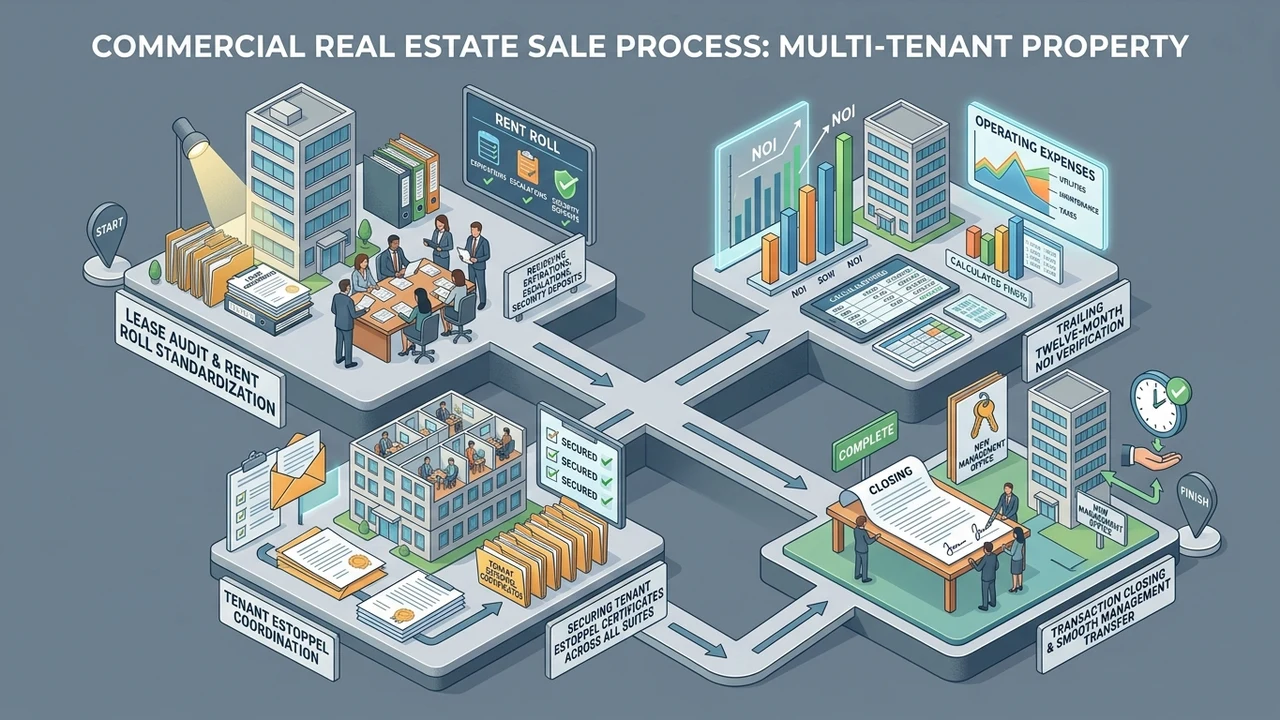
Pull together at least two to three years of income and expense records. Show your real operating expenses, your vacancy rate, and any one-time costs clearly marked as one-time. Buyers reward clean books. To sharpen these numbers, walking through a proper commercial property cash flow analysis helps you present income the way pros expect to see it.
CAM Reconciliation: Do Not Skip It
CAM stands for common area maintenance. These are the shared costs, like parking lot lights, snow removal, and landscaping, that tenants help pay for. A CAM reconciliation is the yearly math where you compare what you collected from tenants to what you actually spent. If you over-collected or under-collected, it must be fixed.
Sloppy CAM math is one of the most common red flags I find. In my experience, roughly 7 out of 10 owners who skip this end up in a fight at closing. Do the reconciliation now, share it openly, and you remove a huge point of stress from the whole deal.
Fix Deferred Maintenance Before Buyers See It
Deferred maintenance is a simple idea. It means repairs you put off for later. A leaky roof, an old HVAC unit, cracked parking lots, or a tired lobby all count. Buyers notice these fast, and every problem they spot becomes a reason to knock down your price.
Here is the hard truth about the numbers. In my experience, buyers ask for about $2 to $3 off the price for every $1 of repair they find during inspection. So a small fix you handle now for $5,000 could save you $10,000 or more at the closing table. Fixing things early is almost always the cheaper path.
You do not have to make the building perfect. You just need to handle the big, obvious stuff and be honest about the rest. A smart move is to get your own commercial property inspection done before you list. Using a commercial property inspection checklist lets you find issues on your terms, not the buyer’s.
Also plan for capital expenditures, or CapEx. These are the big-ticket items, like a full roof replacement or a new parking lot, that do not happen every year. If a major system is near the end of its life, buyers will factor that in. Being upfront about it builds trust and keeps the deal moving.
Handle Tenant Relations the Smart Way
I have handled cases exactly like this before. A tenant hears the word “sale” and starts to panic, wondering if they will lose their space or face a rent hike. A scared tenant might stop paying, might not renew, or might start shopping for a new spot. That can quietly hurt your building’s value right when you need it strong.
Keep your tenants calm and informed, but be careful with timing. In my experience, buildings with happy, stable tenants sell for about 5% to 8% more than ones with tense tenant relationships. Good tenants are part of what you are selling, so treat them like the asset they are.
Here are a few simple rules I follow with tenants during a sale:
- Do not spring the news in a scary or sudden way.
- Remind them their lease protects them, and a sale does not erase it.
- Keep collecting rent and handling repairs like normal.
- Answer their questions honestly, but do not overshare deal details.
- Make sure every lease and deposit record is clean and current.
If keeping tenants happy while you juggle a sale feels like a lot, that is normal. This is where steady help pays off. Our team offers professional property management for commercial buildings, so your tenants stay cared for and your income stays steady while you focus on the deal.
Build a Due Diligence Package Buyers Will Trust
Due diligence is the checking stage, where the buyer digs into every detail before they commit. The smoother this stage goes, the faster you close. So do the buyer a favor and build a clean, organized due diligence package before you even list. It shows you are serious and have nothing to hide.
A ready package can shave weeks off your timeline. In my experience, owners who hand over a full document folder on day one close about 3 to 4 weeks sooner than those who send papers piece by piece. Buyers reward speed and clarity with stronger offers.
Here is what belongs in that folder:
| Document | Why buyers want it |
|---|---|
| Rent roll | Shows all income at a glance |
| Signed leases | Proves the rent is real and legal |
| Estoppel certificates | Tenants confirm their terms in writing |
| CAM reconciliations | Shows shared costs add up fairly |
| 2 to 3 years of expenses | Proves your true NOI |
| Service and vendor contracts | Shows what transfers to the buyer |
| Certificate of occupancy and permits | Proves the building is legal to use |
| Property tax records | Confirms the real tax load |
Add your offering memorandum too, which is a clean summary packet that tells the building’s story with photos, numbers, and lease details. Think of it as the building’s resume. A strong one helps buyers say “yes” faster and helps you stand out in a busy market.
Environmental and Physical Due Diligence Cannot Be Skipped
I have seen this pattern many times in my work. A clean-looking property hides an old dry cleaner, a shuttered auto shop, or a buried fuel tank from decades ago. These past uses can leave pollution in the soil, and that scares away buyers and lenders in a hurry.
This is why buyers order a Phase I environmental site assessment, which is a careful check for signs of past pollution on the land. According to the U.S. Environmental Protection Agency, this study must be done within one year before you buy, and key parts like the site visit and records review must be updated within 180 days (EPA All Appropriate Inquiries). If problems show up, a deeper Phase II study may follow.
Here is why this matters to you as the seller. Under federal law, pollution liability can stick to an owner, so buyers take it seriously. In my experience, a surprise environmental flag can delay a closing by 30 to 60 days or more. If you know your property had a risky past use, get ahead of it and share what you know early.
The physical side counts too. Buyers will inspect the roof, the parking lot, the HVAC, and the structure. A property condition assessment puts real numbers on what needs fixing and when. When your own records match what their inspector finds, trust goes up and price cuts go down.
Check Zoning, Permits, and ADA Compliance
Your building must be legal for how it is being used. That means the zoning must match your tenants, and your permits and certificate of occupancy must be current. In Louisville and greater Jefferson County, zoning rules can be strict, and a mismatch can stall a sale cold while everyone waits for paperwork to clear.
Pull your zoning records and confirm each tenant’s use is allowed. If a tenant’s business does not fit the zoning, fix it before you list. In my experience, zoning and permit surprises are behind roughly 1 in 5 commercial deals that slow down or fall apart, and they are almost always avoidable with early checking.
Accessibility matters too. Under the Americans with Disabilities Act, businesses open to the public must remove access barriers when doing so is “readily achievable,” meaning it can be done without much difficulty or cost. Think ramps, parking spots, and door widths. Small fixes now keep this from becoming a bargaining chip for the buyer later.
If your zoning picture is unclear, do not guess. Getting solid zoning help for your commercial property early can save you weeks of back-and-forth and keep the deal on track. It is far cheaper to fix a zoning question before a buyer’s lawyer finds it.
Think About Taxes and the 1031 Exchange
In my professional experience, sellers lose more money to bad tax planning than to bad pricing. You can negotiate a great sale price and still hand a huge chunk to taxes if you do not plan ahead. The good news is you have legal tools to keep more of your gain, and the best time to set them up is before you sell.
The big one is the 1031 exchange. In simple terms, it lets you roll your profit from this sale into another investment property and delay the capital gains tax. But the clock is tight. The IRS says you must name your replacement property within 45 days of the sale and finish buying it within 180 days (IRS Form 8824 instructions). Miss those dates, and the tax break is gone.

Because those windows are short, you plan before you close, not after. Set up your qualified intermediary and start hunting for the next property early. If you want the full picture, this guide on how a 1031 exchange works on commercial property breaks the rules down step by step in plain language.
Not every seller does a 1031 exchange, and that is fine. Some take the cash and pay the tax on purpose. The point is to choose on purpose, with a plan, instead of getting surprised by a tax bill months later. A short talk with a tax pro before you list is one of the smartest moves you can make.
Price It Right and Time the Market
Price is where deals are won or lost. Set it too high, and your building sits for months while buyers pass it by. Set it too low, and you leave money on the table. The right price comes from your real NOI, a fair cap rate for your area, and honest comparisons to similar buildings that recently sold.
Market conditions shape your timing too. Commercial real estate loan delinquency at U.S. banks sat near 1.56% in early 2026, according to Federal Reserve data (Federal Reserve delinquency rates). That is a moderate level, which means most lenders are still willing to fund solid deals. Healthy lending keeps buyers active, and active buyers mean better offers for you.
An overpriced building carries a hidden cost. In my experience, a property priced 10% too high can sit unsold for 60 to 90 extra days, and by then buyers start to wonder what is wrong with it. That stigma alone can force a bigger price cut than if you had priced it right from day one.
Sometimes the smartest sale happens quietly, away from the crowded open market. If you would rather reach serious, ready buyers without a public listing, we can tap our network of off-market commercial deals in Louisville and match your building with the right one. A quiet sale can protect your tenants and your price at the same time.
Common Mistakes That Slow Down a Sale
I have watched good buildings sit unsold for months. Not because of price. Because of small, fixable mistakes that scared buyers off or slowed everything down. In my experience, about 8 out of 10 stalled deals trace back to problems the seller could have solved before listing.
The pattern repeats so often that I can almost predict it. Here are the mistakes I see most, and what they tend to cost:
| Mistake | What it can cost you |
|---|---|
| Messy or wrong rent roll | Weeks of delay and lower offers |
| Skipping estoppel certificates | Deal can collapse at closing |
| Hiding deferred maintenance | Big price cuts after inspection |
| Sloppy CAM reconciliation | Tenant fights and buyer distrust |
| Overpricing the building | Months sitting on the market |
| No 1031 or tax plan | A large surprise tax bill |
Notice that none of these are about the building being bad. They are about paperwork, planning, and honesty. Fix these six things, and you are already ahead of most sellers out there.
The good news is that every item on that list is in your control. Start early, stay organized, and be upfront. Buyers can feel the difference between a seller who is ready and one who is scrambling, and they reward the ready ones with cleaner, stronger deals.
Final Thoughts
Selling a multi-tenant commercial property the smooth way comes down to one habit: prepare before you list. Clean up your rent roll, gather your leases and estoppel certificates, tidy your NOI and CAM math, and handle repairs and paperwork before a buyer ever asks. Do that, and you turn a stressful sale into a steady, confident one.
Every step here builds trust, and trust is what makes buyers pay more and close faster. You know your building better than anyone. With a clear plan, honest numbers, and the right team beside you, your sale can be smooth from the first showing to the final signature. Have you started getting your building ready yet? I would love to hear where you are in the process.
Frequently Asked Questions
1. How long does it take to sell a multi-tenant commercial property?
Most well-prepared buildings sell within 3 to 6 months, from listing to closing, though it depends on price, location, and market conditions. Buildings with clean paperwork and stable tenants move faster. Ones with messy records or high vacancy can take much longer. Getting your due diligence package ready before you list is the single best way to speed things up.
2. What is an estoppel certificate and why do buyers need one?
An estoppel certificate is a short letter each tenant signs to confirm their rent, lease end date, and that no secret side deals exist. Buyers and lenders use it to make sure your rent roll is true. Without these letters, most lenders will not fund the deal. Getting them signed can take two to four weeks, so ask your tenants early in the process.
3. Do I need a Phase I environmental site assessment to sell?
Usually the buyer orders the Phase I environmental site assessment, which checks for signs of past pollution on the land. The EPA says it must be done within one year of the purchase, with key parts updated within 180 days. If your property once held a gas station, dry cleaner, or auto shop, expect buyers to look closely. Being upfront about the past keeps the deal from stalling.
4. Can I sell without disturbing my tenants?
Yes, and often you should. A quiet, off-market sale can protect your tenants and your price at the same time. Keep collecting rent, keep up with repairs, and remind tenants their leases stay valid after a sale. Calm, stable tenants make your building more valuable, so smooth tenant relations help both sides of the deal.
5. What is a 1031 exchange, and should I use one?
A 1031 exchange lets you roll your sale profit into another investment property and delay the capital gains tax. The IRS gives you 45 days to name the new property and 180 days to close on it. It is a powerful tool if you plan to keep investing, but the deadlines are strict. Talk to a tax pro before you sell so you can set it up the right way.
