

Buying a commercial building is a big step. The money is real. The risk is real. And the stack of papers can feel taller than the building itself. Most buyers I meet aren’t scared of the price tag. They get nervous about numbers they can’t trust.
That worry is fair. It is also easy to fix once you know what “good” looks like. Here in Miami, I’ve watched sharp buyers almost walk away from a solid deal only because the financial records were a mess. The building was fine. The records were the problem. This guide shows you what makes those numbers simple to review, so you can make a clear choice with confidence.
What Do “Financial Records” Mean in a Commercial Property Deal?
When people say financial records, they mean the papers that show how a property makes and spends money. Think of them as the building’s report card. They tell you what comes in, what goes out, and what is left over. For a commercial deal, these papers are the heart of your homework.
This part of buying is called due diligence – a fancy phrase for “do your homework before you pay.” During this process, you review every number the seller gives you. You check the income. You check the expenses. And you look for risks hiding between the lines.
Here are the main documents most buyers will ask to see:
- Rent roll – a simple list of every tenant, what they pay, and when their lease ends
- Income statements – a record of the money the property earned
- Operating expenses reports – the running costs like water, power, and repairs
- Tax returns – the numbers the owner reported to the government
- Lease agreements – the full contracts with each renter
- Maintenance and capital spending history – big fixes like a new roof
Why Clean Financial Records Matter So Much to Buyers
I’ve handled plenty of deals where the whole thing slowed to a crawl for one reason: the seller’s books were a mess. Clean records do more than look nice. They protect your money. When the numbers are clear, you see the true value of the property and spot trouble early. When they are messy, you are basically buying blind.
Here’s the honest truth. In the deals I’ve reviewed, roughly 7 out of 10 problems show up first in the paperwork, not the walls. A leaky roof is easy to see. A lease that ends in three months is not – unless the records tell you. Clean papers turn hidden risks into plain facts you can plan around.
Money is the other big reason. Lenders want proof before they hand over a loan. In my experience, a buyer with tidy financial statements can move toward closing about 30% faster than one stuck chasing missing files. Time is money in real estate. Each extra week of waiting can cost you rate locks, deposits, and sleep.
There’s also your future to think about. The records you get today become the base for your own ownership tomorrow. If you can’t understand them now, you’ll struggle to run the building later. Clean books help you plan repairs, set rent, and prove your returns when you sell. Good numbers are a gift you give your future self.
The Key Documents Buyers Should Ask For
Every strong review starts with the right documents. Ask for too little and you miss risks. Ask for the right list and the property starts to make sense fast. I always hand buyers a short, clear request list so nothing slips through. A good commercial real estate deal lives or dies on these papers.
Below is a simple table of the documents I ask for and what each one shows you. Keep this handy when you make your own request to a seller.
| Document | What It Tells the Buyer |
|---|---|
| Rent roll | Who rents, what they pay, and when leases end |
| Income statements | The money the property brought in |
| Operating expenses report | The cost to run the building each year |
| Tax returns (last 3 years) | Income the owner reported to the IRS |
| Lease agreements | The full rules for each tenant |
| Title report | Who legally owns the property and any debts on it |
| Environmental reports | Any pollution or soil issues on the land |
| Capital spending log | Big fixes like roofs, parking lots, and HVAC |
| Insurance records | Past claims and current coverage costs |
| Permits and inspection files | Legal proof the building is up to code |
Ask for at least three years of history on the money items. One year can hide a bad trend. Three years shows the real pattern. If a seller can only give you a few months, treat that as a small warning sign. A well-run building keeps detailed files, and a serious seller shares them without a fight.
Want a deeper checklist for the physical side of the deal? My commercial property inspection checklist walks through what to look at once the numbers check out.
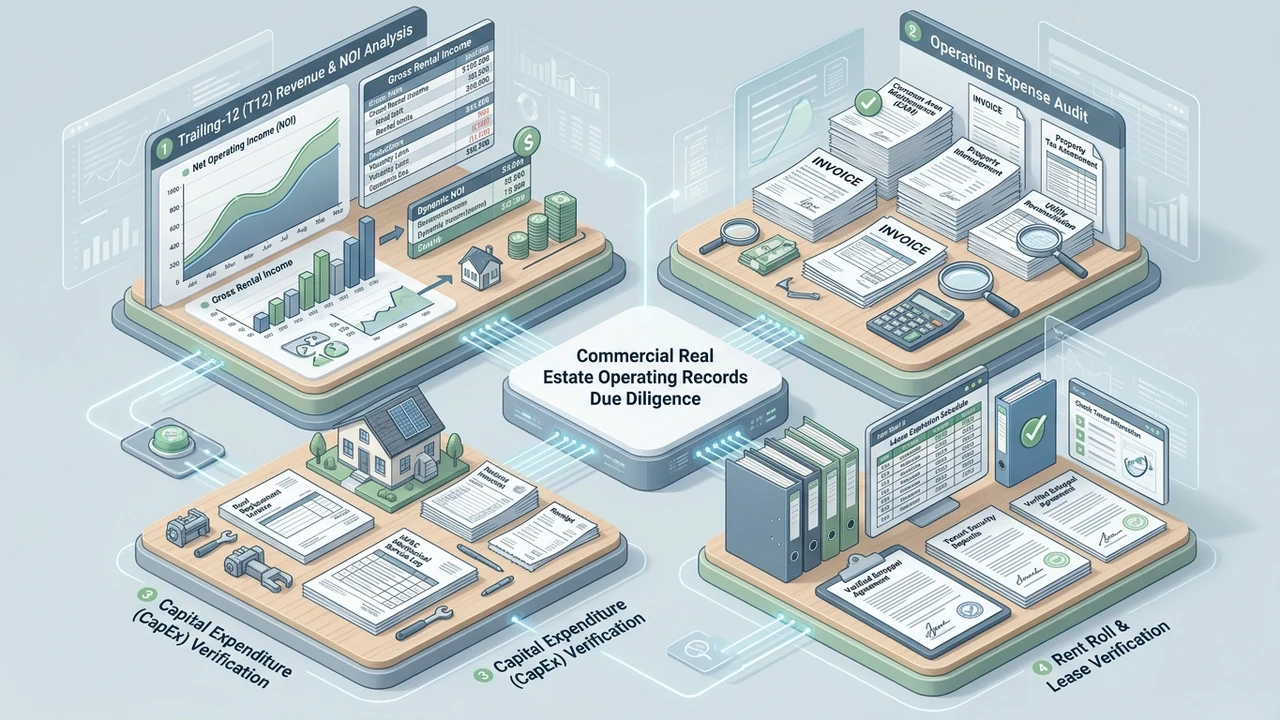
What Makes These Records “Easy” to Review (The Real Answer)
In my experience reviewing hundreds of files, the easy ones all share one trait: every number ties back to a bank statement. That’s the real secret. Easy records are not fancy. They are honest, complete, and organized. When the paper says the building earned a certain amount, the bank deposits should match. Simple.
So what actually makes a set of financial records easy to review? A few plain things:
- Consistency – the same format each month and each year
- Completeness – no missing months and no blank gaps
- Proof – every claim backed by a bank statement or receipt
- Clear labels – line items named in plain words, not codes
- Digital access – files you can search, not a shoebox of paper
- Reconciliation – the statements match the tax returns and bank records
Here’s a quick side-by-side of what messy files look like versus clean ones. I’ve read both many times, and the difference is night and day.
| Messy Records (Hard to Trust) | Clean Records (Easy to Review) |
|---|---|
| Handwritten notes and loose receipts | Typed reports in a shared folder |
| Missing months or random gaps | A full 12-month T-12 report |
| “Cash” income with no proof | Bank deposits that match the income |
| Vague labels like “misc.” | Clear labels for each expense |
| Numbers that don’t match tax returns | Numbers that tie out across all files |
A T-12 is just a report showing the last twelve months of income and costs in one place. When a seller hands me a clean T-12 that matches the tax returns, my job gets easy. In fact, about 8 out of 10 of my smoothest closings started with well-kept books. Good paperwork is a signal. It tells you the owner ran the place with care.
The Rent Roll: The Buyer’s Best Friend
If I could only see one document before buying, I’d pick the rent roll. It’s a simple list, but it holds so much. It shows every tenant, the rent they pay, the size of their space, and the day their lease ends. In one page, you see how healthy the income really is.
A clean rent roll answers big questions fast. Are tenants paying market rent or old, low rates? Do three leases end next year, leaving you with empty space? Is one big renter paying half the total rent? These answers shape the true value of the deal. I’ve seen a pretty building lose half its worth once the rent roll showed leases about to expire.
Watch for a few things when you read it. Look at the mix of tenant types. Look at how long each renter has stayed. Long, steady tenants are gold. Short leases and lots of turnover mean more risk and more costs down the road. In my deals, buildings with tenants who stayed 5 years or more sold for noticeably stronger prices.
Numbers on a rent roll should match the leases and the income statements. If the roll says one thing and the lease says another, stop and ask why. Small gaps happen. Big ones are red flags. Before you trust any roll, read the actual contracts behind it – my guide on how to evaluate tenant leases before buying property shows you exactly what to check.
Income and Expense Statements: Reading the Real Numbers
I’ve seen sellers pad their income more times than I can count. Not always on purpose – sometimes they just forget the messy stuff. Your job is to find the real number, not the pretty one. Income and expense statements show the money in and the money out. The gap between them is your reward for owning the place.
The key figure here is net operating income, or NOI. That’s the money left after you pay the running costs but before the loan payment. Buyers and lenders live by this number. A clean statement makes NOI easy to see. A messy one hides it. In most deals I review, a 10% swing in reported NOI can change the price by tens of thousands of dollars.
Watch the operating expenses closely. Sellers sometimes leave out costs they paid themselves, like their own labor or a family member’s help. When those costs come back after you buy, your profit shrinks. I always add back a fair number for maintenance and management, even if the seller shows zero. Nine times out of ten, the “too good” expense number is missing something.
One-time costs matter too. A new roof is a capital expense, not a yearly bill. Mixing the two makes the numbers lie. Split them so you see the true, repeating performance. To go deeper on turning these statements into a clear picture of profit, my commercial property cash flow analysis guide breaks it down step by step.
Tax Returns and Bank Statements: The Proof Behind the Numbers
Anyone can type a nice number into a spreadsheet. Tax returns and bank statements are harder to fake. That’s why I treat them as the truth test. If the income on the seller’s report matches the tax returns and the bank deposits, you can breathe easy. If they don’t match, you’ve found a problem worth chasing.
Sellers rarely overstate income on their taxes, because higher income means a higher tax bill. So the tax returns often show the honest floor. Compare them to the glossy income statements the seller hands buyers. A small gap is normal. A big gap between the two needs a clear answer before you move ahead.
The IRS explains that businesses should keep tax records for at least three years in most cases, and sometimes longer. So a serious owner should have them ready. When a seller “can’t find” the returns, that tells you something about how the place was run. Good owners keep this paperwork close, because they know buyers and lenders will ask.
Bank statements are the final check. Match the monthly deposits to the rent the rent roll claims. Match the withdrawals to the expenses on the report. When these three sources agree, the deal’s numbers are solid. This simple cross-check has saved my clients from more than one bad purchase. And once the deal is done, that same clean paperwork helps you claim the tax benefits of owning commercial property without a headache at filing time.
Leases, Contracts, and Other Paperwork That Tell the Story
In my work, the leases tell the real story that a summary sheet tries to hide. A one-line entry on a rent roll can’t show you the fine print. The full lease agreements can. They spell out who pays for repairs, who covers insurance, and what happens when a tenant leaves. That fine print changes your future costs a lot.
Pay close attention to who pays for what. In a triple-net (NNN) lease, the tenant pays taxes, insurance, and maintenance. In a gross lease, the owner pays most of it. This one detail can swing your yearly expenses by thousands. About half the confused buyers I meet didn’t read this part and got a nasty surprise later.
Other papers fill in the gaps. Estoppel letters – short notes where each tenant confirms their rent and lease terms are true – protect you from surprise claims. Service agreements for things like landscaping or elevators show ongoing costs. Permits and inspection files prove the building is legal. Missing permits can mean big fines or forced repairs after you buy.
Don’t skip the title work here either. A clean title proves the seller truly owns the place and shows any debts tied to it. Environmental reports and maintenance logs round out the picture. Each document you gather makes the deal clearer and lowers your risk. The goal is simple: no surprises after closing.
Red Flags That Make Records Hard to Review
Some warning signs show up again and again. Once you learn them, you’ll spot trouble in minutes. Messy books don’t always mean a bad seller. But they always mean more work and more risk for you. When I see these signs, I slow the deal down and dig deeper before anyone signs.

Here are the red flags I watch for most:
- Missing months in the income or expense reports
- Handwritten ledgers with no bank proof
- Cash income that no deposit backs up
- Numbers that don’t match the tax returns
- Vague labels like “other” or “misc.” hiding big costs
- No record of capital repairs on an older building
- A seller who says “just trust me” instead of showing files
Any one of these can be innocent. Two or three together is a pattern. In my experience, deals with three or more of these flags fall apart about 60% of the time, or the price drops hard once the truth comes out. That’s not bad luck. That’s messy records finally catching up with the seller.
The fix is patience. Ask for the missing piece. Give the seller a fair chance to explain. Honest owners usually clear it up fast. When the answers keep dodging your question, trust the pattern, not the promise. Walking away from a bad set of books has saved my clients far more than it cost them.
How Miami’s Market Adds a Few Wrinkles
I’ve closed enough deals in South Florida to know that insurance can make or break the numbers here. Miami is a wonderful place to own commercial property, but our weather changes the math. Storm risk, flood zones, and high insurance costs all show up in the financial records. If you skip these, the expenses you inherit can shock you.
Start with insurance. In Miami, wind and flood coverage can cost far more than in most of the country. I’ve seen insurance eat up 15% to 25% of a building’s yearly operating expenses here. Check the seller’s past premiums and any claims history. A building with lots of storm claims will cost you more to cover, and that hits your NOI right away.
| Miami Cost to Watch | Why It Hits Buyers Here |
|---|---|
| Wind & flood insurance | Storm risk pushes premiums well above the national norm |
| Property taxes | Values can reset higher right after a sale |
| Storm maintenance | Roofs and windows face heavy wear from heat and salt air |
| Environmental checks | Coastal soil and water need a closer look |
Flood zones matter too. The EPA sets the rules for the environmental checks – called All Appropriate Inquiries – that buyers do before buying commercial land. In a coastal market like ours, a Phase 1 environmental review is smart money. It flags soil, water, and pollution issues that old paperwork might miss. Better to know now than after you own it.
Property taxes and condo or association fees are the last local wrinkle. Florida values can jump after a sale, so last year’s tax bill may not match your future one. Read the records, then check current Miami rates. Local knowledge here is worth a lot. If you’re weighing a South Florida building and the numbers feel foggy, we can sit down together and walk through them line by line.
Simple Steps to Review Financial Records Without Getting Lost
You don’t need to be an accountant to review a building’s books. You need a plan and a little patience. I give every first-time buyer the same simple process. Follow it in order, and the scary pile of paper turns into a clear story you can read.
Here’s the step-by-step I use:
- Step 1: Gather all documents first. Don’t start until you have three years of files.
- Step 2: Read the rent roll and match it to the leases.
- Step 3: Check the income statements against the bank deposits.
- Step 4: Compare the reports to the tax returns.
- Step 5: Add back missing expenses like maintenance and management.
- Step 6: List every risk you find and ask the seller to explain.
Take notes as you go. Write down each question the moment it pops up. In my experience, buyers who work through this list catch about 90% of the money problems before closing. The other 10% is why you bring in a pro for a second look.
New to all this? You’re not alone. Most of my first-time clients feel lost on day one and confident by the end. If you want a hand mapping your loan against these numbers, the different commercial real estate financing options can change how much cushion you really have. Line up the money side early so nothing stalls at the finish line.
How a Good Advisor Makes the Whole Thing Easier
I’ve sat across from too many buyers who tried to read a T-12 alone and gave up halfway. There’s no shame in it. These files take practice. A good advisor reads them fast, spots the traps, and turns confusing numbers into plain English. That help often pays for itself many times over.
A pro does more than read papers. They know the local market, the fair rent, and the real costs in Miami. They ask the seller the sharp questions you might miss. In my deals, buyers who used an experienced guide caught problems worth an average of several thousand dollars that they would have paid for later. That’s real money saved.
Financing help matters too. Many buyers use loans backed by the U.S. Small Business Administration to buy their first building, and those lenders want clean financial statements before they say yes. A messy file can sink your loan. A tidy one, packaged well, speeds up the whole transaction. Good advisors know how to present your numbers so lenders trust them.
The same goes for life after closing. Running a building is its own job. If you’d rather not chase rent and repairs yourself, professional help managing a commercial building keeps your records clean from day one – which makes your own future sale far easier. If the numbers on a deal feel like too much, reach out and we can review them with you before you commit a dollar.
Final Thoughts: Making the Numbers Simple
Clean financial records turn a scary purchase into a smart one. They show the true value, flag the risks, and help you buy with a clear head. The best deals I’ve done in Miami all started the same way – with honest, complete, well-organized books. Messy files don’t always kill a deal, but they always cost you time and worry.
So ask for the right documents. Match every number to real proof. Read the leases, check the taxes, and watch the local
